
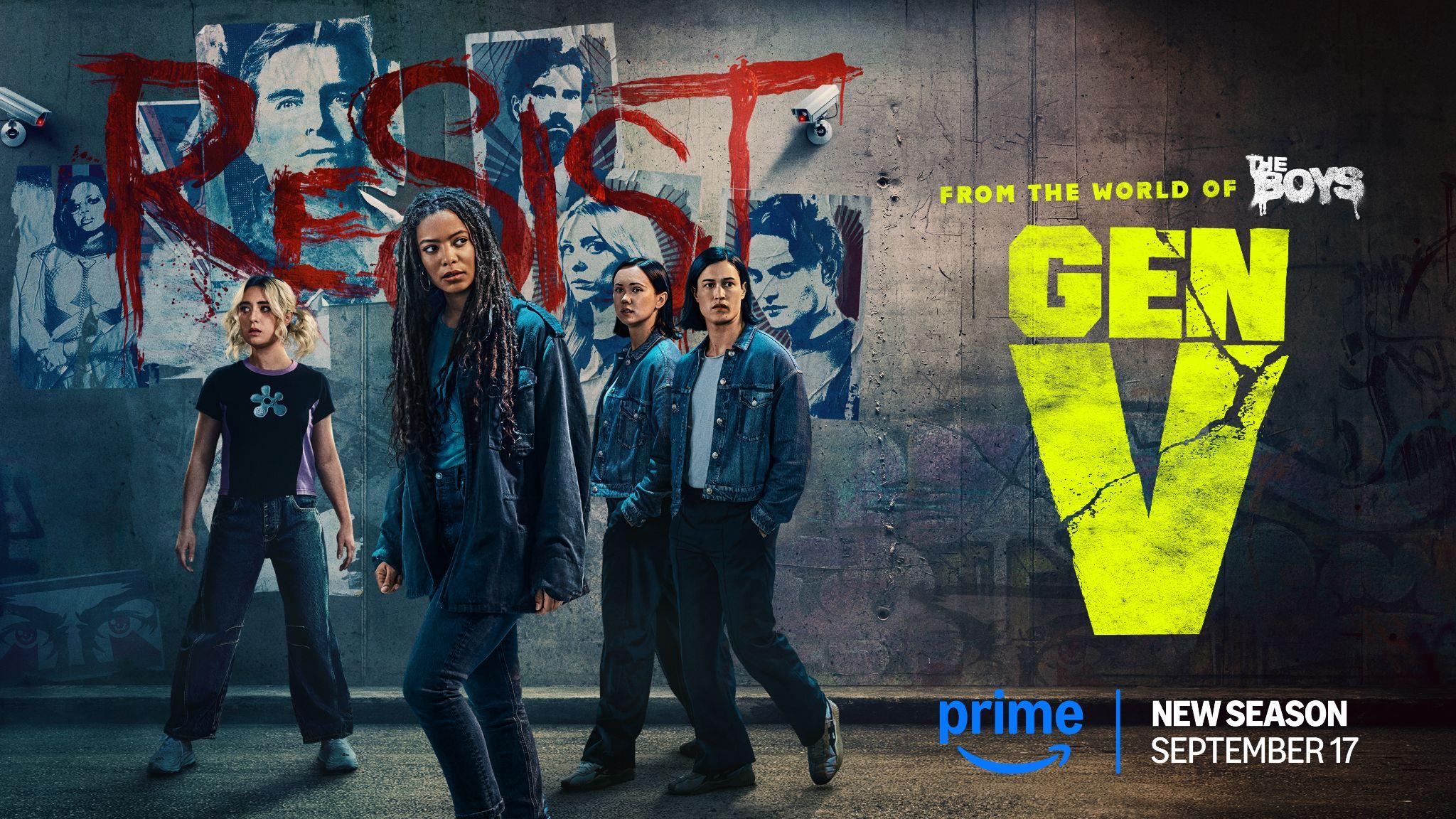
Gen V Season 2 hit differently — here's a full breakdown of the Project Odessa bombshell, the Dean Cipher theory, Andre's tribute, Jordan's sacrifice, and what it all means for where this season is heading.
Introduction: This Is Not the Same Show Anymore
I finished the three-episode premiere of Gen V Season 2 and just sat there for a minute.
Not the good kind of stunned silence where everything resolved satisfyingly. The kind where you're trying to figure out how many separate things you're upset about simultaneously, and the answer keeps getting larger.
The Boys universe has always been willing to go to uncomfortable places. That's part of the deal. You sign up for the satire, the body horror, the unflinching look at what power does to people who have too much of it and what it does to people who have none. But Gen V Season 2's premiere feels different in a way that's worth naming before we get into specifics.
It feels heavier. More personal. Like the show finally recalibrated its relationship with these characters from "young people navigating a corrupt system" to "children being destroyed by a machine that was built specifically to use them up."
That shift in register changes everything about how the premiere lands. The gore is still there. The Vought satire is sharper than ever. But underneath all of it is something that functions closer to tragedy than thriller, and the first three episodes establish that register without flinching.
My rating: 6.5/10 for the premiere block — and I want to be clear that the score reflects where the season is starting rather than a judgment on the quality of the writing, which is genuinely strong. This is dark, intentionally messy television that is doing something more ambitious than its first season, and it needs room to develop. The foundation being laid here is serious.
Full spoilers for all three premiere episodes follow.
For Chance: Getting the Tribute Right
Before anything else — before the plot breakdown, before the theories, before the analysis of what Project Odessa means for Marie's identity — we need to talk about the tribute.
The "For Chance" title card appears right at the opening, and if you weren't already braced for it, it hits harder than you expect. Losing Chance Perdomo was a genuine blow to this community, and the anxiety around how the writers would handle Andre's absence was real and legitimate. There are so many ways to get this wrong: a hasty recast, an off-screen disappearance that treats the character as disposable, or worse, a death that uses the real loss as cheap emotional manipulation without actually honoring who Andre was.
The choice they made — having Andre die from a stroke while using his powers to break his friends out of the Elmira facility — is the right one, and I say that having thought carefully about why.
It's consistent with the show's central thesis: the Compound V gifts are not gifts. They are biological modifications that Vought designed for Vought's purposes, and the human bodies carrying them pay the price. Andre's death from the effort of heroism is not random tragedy. It's the show's argument made flesh — the system literally kills the people who try hardest to use what it gave them for something genuine.
Polarity's grief, filtered through his own ongoing struggle with the brain damage from his powers, adds a layer that the premiere handles with real restraint. This is a man watching his son die from the same thing that's been slowly taking him. The parallel isn't stated explicitly. It doesn't need to be.
Rest in power, Chance Perdomo. The show honored both the character and the person who played him.
1967 and Project Odessa: Vought's Body Count Has Been Building for Decades
The 1967 flashback sequence is the premiere's most important structural piece, and it's easy to underestimate it while you're watching because it functions mostly as atmosphere and world-building in the moment.
What it's actually doing is establishing the timeline of Vought's failure.
Thomas Godolkin overseeing the early Project Odessa experiments is a masterclass in the show's specific brand of body horror, but the horror isn't primarily about the gore — it's about the casualness. Scientists melting and exploding because their human bodies can't process the Compound V they've been administered is presented as a setback, not a catastrophe. An engineering problem to be iterated on. The human cost is completely secondary to the research progress.
This is what "failing upward" looks like institutionally. For more than fifty years, Vought has been producing exactly this kind of outcome — bodies in the wake of experiments that didn't work, lessons nominally learned but never actually absorbed, the machine continuing to run because the machine's continuation is the point. The students at Godolkin University in 2024 are downstream of decisions made in 1967 that nobody was ever held accountable for.
The flashback makes everything happening in the present tense feel less like a new crisis and more like the latest iteration of a very old one.
Dean Cipher: The Theory That Changes Everything
I am going to lay out the Dean Cipher theory clearly, because if it's correct, it recontextualizes the entire season.
Dean Cipher is wrong. Not wrong in the sense of being evil — though he is — but wrong in the sense of being fundamentally off. The protein shake blending chicken and peanut butter is a small detail that lands as a character quirk until you start accumulating the other details alongside it. His clipped, robotic speech patterns. His refusal to allow Kate anywhere near his mind. His specific, almost obsessive focus on "perfecting" the students rather than developing them. His connection to "Dr. Gold" and the early Odessa research.
Each individual element is explainable in isolation. Together, they point in one direction: Dean Cipher is Thomas Godolkin.
The precise mechanism — consciousness transfer, brain transplant into a younger body, some other Vought-specific biological procedure that the 1967 flashback suggests they've been working toward — is less important than the implication. If Cipher is Godolkin, then the man who designed Project Odessa is still running it. The experiment never ended. The university was never an education institution; it has always been a laboratory, and the students have always been the subjects.
His refusal to let Kate read his mind is the detail I keep coming back to. Kate's power is the most direct threat to this theory, and Cipher's specific, deliberate avoidance of it is too pointed to be coincidence. Whatever is behind that refusal, it's something he cannot afford to have exposed.
Vought's Propaganda Machine: The Part That's Almost Too Realistic
The propaganda video that opens the new semester is the premiere's sharpest piece of satire, and I mean that as a genuine compliment even though watching it is deeply uncomfortable.
Vought has reframed Victoria Neuman's death as a "Deep State" conspiracy orchestrated by Robert Singer. The people actually responsible for the Godolkin massacre — Kate and Sam — have been rebranded as the "Guardians of Godolkin." And the students who survived and tried to tell the truth were rotting in the Elmira facility while the official narrative was being constructed around them.
The reason this lands so hard is because it's not exaggerated. This is exactly how institutional narrative management works — not through overt censorship but through the control of framing. By the time Marie, Jordan, and the others get back to campus, the story has already been told. The "truth" has been established. Any contradicting account is now, by definition, the conspiracy theory.
The campus itself has transformed in ways that underline where the Vought worldview leads when given enough time and enough institutional control. "Influencer" classes taught by Modesty Monarch exist alongside the barbed wire literally separating Supe students from the human workers. The hierarchy isn't implied anymore. It's infrastructure.
This is the show's argument about where unchecked power goes when you let it run long enough: not to dramatic villainy, but to the mundane, bureaucratic normalization of a caste system. The barbed wire isn't there to oppress — in Vought's framing, it's there for "safety." The rebranding is complete.
Marie Is Project Odessa: The Reveal That Reframes Her Entire Story
The Starlight appearance is earned and handled well — having Annie January show up to pull Marie out of immediate danger gives the season a spy thriller thread that works within the larger story — but it's the secondary reveal in that same sequence that is the premiere's real bombshell.
Marie is Project Odessa.
The birth certificates hidden in the Confederate frat house — all those babies labeled "deceased" except for one — connect Marie directly to the same era and the same laboratory as Homelander. She isn't just someone who happened to develop unusual powers. She was designed. Built for a specific purpose, with Homelander's generation as the context and his capabilities as the benchmark.
The likely implication — she was made to be his peer, or his replacement, or some kind of check on him that Vought built into the system before it lost control of what Homelander became — is exactly the kind of long-game institutional thinking that makes the Vought mythology so coherent. They don't just create Supes. They create relationships between Supes, hierarchies and counterweights that they intend to control. The problem is that the subjects have a tendency to develop in directions the researchers didn't predict.
But the layer that makes this revelation genuinely cruel rather than just plot-significant is what it means for Marie's family.
The Compound V treatment that created Marie may also be responsible for fixing her mother's fertility issues, which means Annabeth — Marie's sister — might only exist because of what was done to Marie before she was born. Marie is the reason her family existed. She is also, in the way the accident unfolded, the reason her parents are gone. The system that created her built in a specific kind of psychological devastation: a person who is simultaneously the source of everyone she loves and the cause of their loss, with no clean way to separate those two facts.
That is a level of institutional cruelty that the show has been building toward, and it's darker than most of what Gen V Season 1 attempted.
Sam's Spiral: The Kid Who Was Never a Monster
Watching Sam without Kate's emotional stabilization is some of the most genuinely difficult viewing in the premiere, and it's difficult in the right way.
The hallucinations and the spiral of guilt — particularly over what he did to Kimiko and Frenchie, characters the audience has spent years caring about in The Boys — prove something the show has been building toward since Season 1. Sam is not what Vought designed him to be. He is not the weapon they wanted. He is a broken kid carrying damage that was done to him before he had the capacity to consent to any of it, and he is trying, badly and without adequate support, to live with the consequences of actions that were shaped by that damage.
The show is careful not to let this function as a full absolution. What Sam did had real consequences. But it refuses to let Vought's framing — "he's dangerous, he's unstable, he needs to be controlled" — be the final word. The hallucinations are the remnant of what the Woods did to him. The guilt is proof that he knows the difference between right and wrong. A monster doesn't spiral from guilt. A monster doesn't mourn.
Jordan's Sacrifice: The Most Heroic Thing Anyone Has Done
The Jordan Lee ending is the premiere's emotional peak, and I want to make sure it gets the attention it deserves because it's easy to rush past it in the density of everything else happening.
Jordan has always been the pragmatist of the group. The one calculating angles, weighing outcomes, trying to figure out how to survive the game rather than how to change it. That's not cynicism — it's a reasonable adaptation to a system that rewards compliance and punishes deviation, and Jordan has always understood the system clearly.
Which is exactly why "Godolkin Day" hits so hard.
Going off-script to expose the Elmira facility — to use a public platform, in front of a crowd that has been thoroughly prepared to hear the official narrative, to tell the truth about Andre and about what was done to the people who survived — is not a tactical decision. It's not calculated. It's the choice you make when you have decided that the cost of continuing to play the game is higher than the cost of being honest.
The crowd turning on Jordan instantly, the "traitor" label attaching in real time before the episode cuts to black — it's the show demonstrating exactly how the propaganda works at the individual level. Jordan told the truth on a stage in front of hundreds of people, and within seconds the framing had flipped. The truth-teller is the threat. The institution is the victim.
That pit in the stomach as the screen goes dark is the feeling the premiere has been building toward across three episodes. The masks are off. And the system is ready for that.
What's Being Set Up: Reading the Season's Architecture
Three episodes in, the season's structural intentions are becoming clear.
The Cipher-as-Godolkin thread is the central mystery, and it's positioned to reframe the entire university as a continuous experiment rather than an institution with a complicated history. If Godolkin has been running Godolkin University — personally, continuously, from a new body — then everything the students have experienced there has been curated.
Marie's Project Odessa identity puts her in direct opposition to both Vought's plans and Homelander's sense of his own uniqueness. A designed peer is a threat in ways that an accidental power manifestation isn't.
Sam's instability without external support is a ticking clock that the season will presumably use as both dramatic tension and thematic argument — about what the system does to people it modifies and then abandons.
And Jordan's public exposure of the truth is the season's first genuine act of resistance. Not survival, not accommodation, not finding a way to work within the system. Resistance. The question now is what it costs.
Common Questions About What's Going On
What is Project Odessa exactly? Based on what the premiere reveals, Project Odessa was an early Vought Compound V research program operating in the 1960s under Thomas Godolkin. It involved administering V to human subjects in ways that frequently killed them, and it appears to be the origin point for Marie's existence as a designed Supe rather than an accidental one.
Is Dean Cipher confirmed to be Thomas Godolkin? Not confirmed yet — the premiere establishes the theory through accumulated detail rather than direct revelation. The refusal to let Kate read his mind is the strongest single piece of evidence, but the show hasn't made the connection explicit as of the first three episodes.
What happened to Andre between Season 1 and Season 2? Andre died from a stroke caused by overusing his powers during an attempt to free his friends from the Elmira facility. The premiere handles his death as a tribute to Chance Perdomo, who passed away before Season 2 began filming.
What does Marie being Project Odessa mean for her relationship with Homelander? The implication is that she was designed to exist in relation to Homelander — as a peer, a check, or a replacement. What Homelander does with that information, if he learns it, is one of the season's most significant open questions.
Who is Modesty Monarch? Modesty Monarch is introduced in the premiere as a social media influencer Supe now teaching classes at Godolkin that are essentially courses in building a personal brand and navigating Vought's public ecosystem. She functions as a symbol of what the university is becoming under Vought's tightened control.
What the Premiere Gets Right
The thing Gen V Season 2 does in its premiere that the first season didn't fully commit to is treating the institutional horror as the primary genre rather than the backdrop.
Season 1 was a college drama with superhero horror elements. The Vought machinery was present and sinister, but the intimate character stories — the friendships, the rivalries, the coming-of-age beats — were the foreground.
Season 2 inverts that relationship. The institution is the foreground now. The character stories are happening inside a machine that is actively working to consume them, and the premiere is clear that the machine is winning. Andre is dead. Jordan is about to face consequences for honesty. Sam is spiraling. Marie is discovering that her identity is a product of the same system she's been trying to resist.
The show is asking something harder than Season 1 asked: what do you do when you discover that everything about you — your powers, your history, your family's existence — was engineered by something you're trying to fight? Is resistance even coherent when you are, in some fundamental sense, a product of what you're resisting?
That's a genuinely difficult question, and the premiere earns the right to ask it by not pretending it has an easy answer.
Conclusion: The Machine Was Always Running
Gen V Season 2's premiere block is not comfortable television. It's not supposed to be.
It's a story about children discovering that they were never students — they were always subjects. That the institution built around them was designed to use them up, and that the people who designed it may still be in the building. That the propaganda works. That telling the truth in public, in front of witnesses, doesn't change the narrative if the institution controls the framing.
And underneath all of that — underneath the body horror and the political satire and the Vought mythology — it's a story about grief. About Andre, specifically, and about what it means that the show has to continue without Chance Perdomo.
The tribute is handled with genuine care. The season is taking what it's been given — the loss, the weight of it, the way it changes what was already a story about young people being failed by adults — and using it honestly. That takes courage, and the premiere earns it.
I'm scared for Marie. I'm genuinely worried about Sam. I need to know what's behind Cipher's door and whether my theory about who he is will hold.
Drop your thoughts in the comments — especially about the Godolkin theory. I cannot be the only one who needs to talk this through.
.png)


No comments:
Post a Comment