
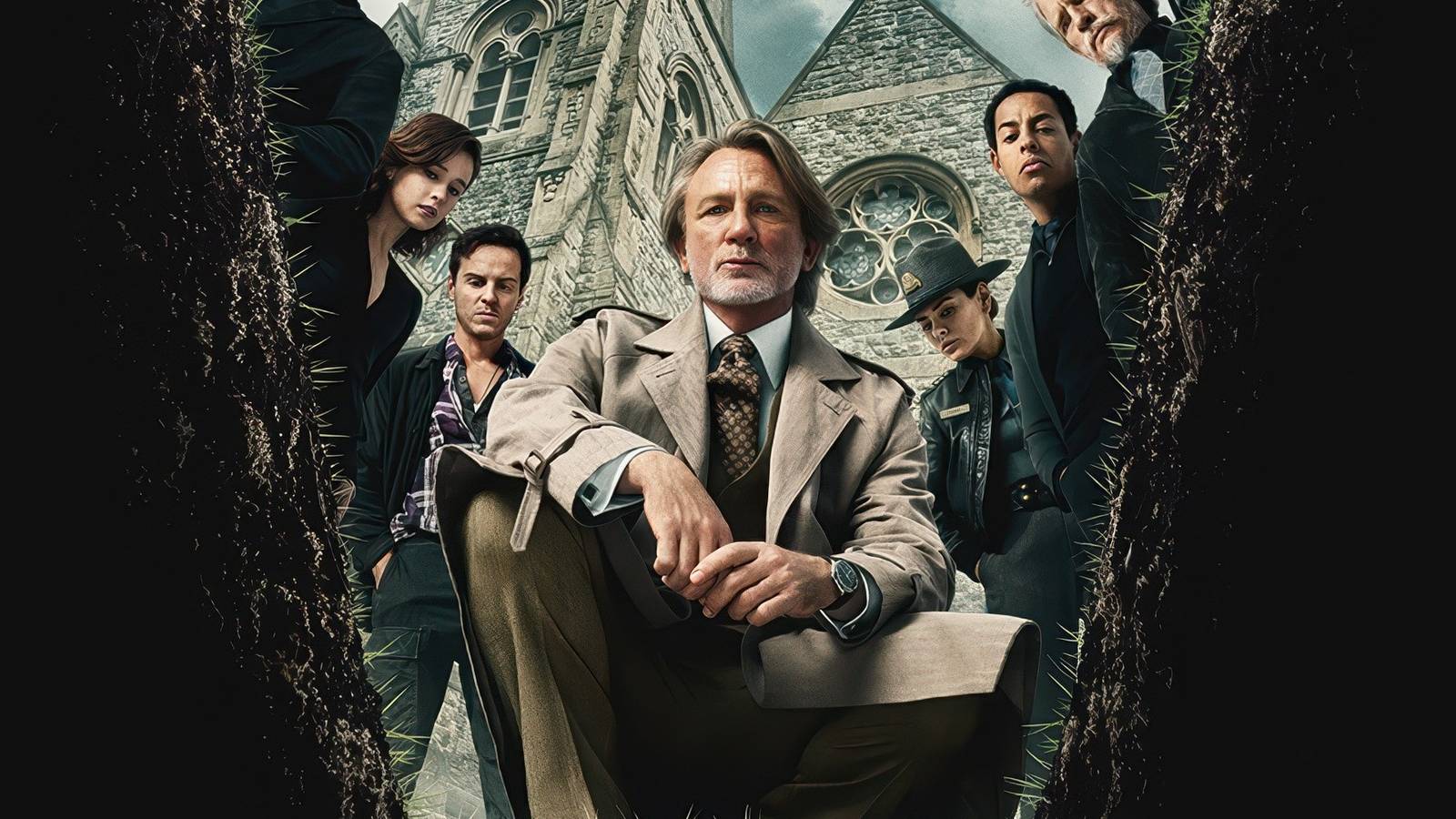
Rian Johnson's Benoit Blanc trilogy is almost complete. Before Wake Up Dead Man arrives, here's the full recap of Knives Out and Glass Onion — every twist, every villain, every moment that matters.
Introduction
Benoit Blanc is coming back. And whether you've been obsessively rewatching the first two films or you're just now realizing that Thanksgiving might sneak up on you faster than you expected, this is the right time to get caught up.
Rian Johnson's mystery trilogy is something genuinely rare in franchise filmmaking: a series of films that are thematically connected through a detective and his methods but structurally completely different in setting, tone, and target. The first is a cozy, warm, Christie-flavored murder in a Massachusetts estate. The second is a blinding, satirical explosion set on a Greek billionaire's island. The third — Wake Up Dead Man — is apparently darker, more gothic, and based on everything the title suggests, possibly the most emotionally demanding of the three.
To be ready for it, you need to understand not just what happened in the first two films but what they were doing — the specific way Johnson uses the mystery genre as a vehicle for something sharper and more pointed than a whodunit. These films aren't just puzzles. They're arguments.
Let's go through both of them properly before the new case opens.
Knives Out: The Case That Started Everything
Rating: One of the best mystery films made in the past twenty years. I'll stand by that without qualification.
Knives Out is the film that proved the classic mystery — the country house, the eccentric family, the brilliant detective — still had enormous vitality left if you were willing to use it as a scalpel rather than a prop. Agatha Christie's ghost is present throughout, but Johnson isn't trying to recreate the Golden Age. He's trying to use its structures to say something about how money and power work in the contemporary world.
The setup is the familiar one: Harlan Thrombey, legendary crime novelist, is found dead the morning after his 85th birthday party. His throat has been cut. It appears to be suicide. An anonymous client has hired Benoit Blanc — Daniel Craig operating at the peak of his comedic timing, somehow managing to play broadly ridiculous and quietly intelligent simultaneously — to investigate anyway, because the anonymous client knows something was wrong at that party.
The family assembled at the Thrombey estate is the film's central pleasure and its central argument. Every member of this household presents themselves as self-made, independent, personally accomplished. Every member of this household is, on closer examination, entirely dependent on Harlan's money, Harlan's influence, or Harlan's willingness to overlook what they're doing with both.
Walt manages the family publishing company, which means his entire professional identity and authority are extensions of his father's creative work. The moment Harlan announces he's taking back control of the business, Walt isn't losing a job. He's losing the only evidence he has that he's a real person.
Richard is the son-in-law who has constructed an elaborate public persona around traditional values while conducting an affair and hiding correspondence that would destroy him. He has the specific energy of someone who has spent so long performing virtue that he's confused the performance with the reality.
Joni is the lifestyle guru double-dipping on the tuition checks Harlan was writing for her daughter's education — cashing them twice, spending the money on herself, presenting herself publicly as a figure of mindfulness and authentic living. She is the film's funniest and most precise portrait of performative progressivism in the service of personal greed.
And then there's Marta — Ana de Armas giving a performance that carries the entire film's emotional weight. She was Harlan's nurse. She was, more importantly, the only person in his life who treated him as a person rather than a financial resource. Her quirk — the physical inability to lie without vomiting, the "honest witness" mechanism Johnson uses to both play with and subvert our expectations — is the film's central narrative device.
The Twist That Still Hurts
The setup Johnson constructs is this: Marta believes she accidentally switched Harlan's medications, giving him a lethal overdose. Harlan, in an act of both love and the kind of elaborate plotting you'd expect from a mystery novelist who has spent eighty-five years thinking about exactly this kind of scenario, creates a watertight alibi for her and takes his own life to ensure she isn't charged.
The "doughnut hole" — Blanc's framework for understanding that the absence in the middle of a mystery is the mystery itself — leads him to Ransom Drysdale, played by Chris Evans with the specific, practiced charm of someone who has never in his life been made to face a real consequence.
Ransom knew about the will change that would give Marta everything. He switched the medication vials to frame her for Harlan's death, ensuring the will would be contested and he'd have grounds to challenge it. The tragic irony is that Marta is an expert nurse who identified the correct medication subconsciously by its tactile properties. She never made the mistake Ransom tried to frame her for. She gave Harlan the right medication. He died believing he was saving her from an error she never committed.
That's the emotional gut punch that separates Knives Out from a clever puzzle. It's not just a well-constructed mystery. It's a story about a good man who loved someone enough to die for them, and who died for nothing because the threat he was protecting her from was never real.
The final image — Marta on the balcony, the disinherited family on the lawn below, the "My House" mug — is one of the most satisfying endings in recent cinema. Not because justice is uncomplicated, but because the film has spent two hours demonstrating exactly who these people are and what they deserve, and then delivers accordingly.
Glass Onion: The Sequel That Changed the Rules
Rating: Loud, confident, brilliantly constructed, and a genuine evolution from the first film.
For the sequel, Johnson traded the warm autumnal tones of the Thrombey estate for the blinding white light and hard surfaces of a private island in the Aegean. The aesthetic shift is the point: Glass Onion is about transparency that isn't actually transparent, clarity that is actually performance, and the specific way that powerful people use the appearance of openness to conceal the simplest and most squalid motivations.
The setting is Miles Bron's private island, where the tech billionaire — played by Edward Norton with the specific, carefully calibrated energy of someone who has spent years studying the actual tech billionaires he's satirizing — has invited his inner circle for a murder mystery party. The guests are a senator compromising her ethics for his backing, a scientist whose findings he's been suppressing, a fashion designer he's rescued from cancellation, a streamer who has built an audience from manufactured outrage, and Andi Brand.
The Andi Brand situation is where Glass Onion gets its soul.
The Sisterly Revenge
The film reveals — in a structural move that Johnson executes with genuine elegance — that the "Andi" who arrived on the island is actually Helen Brand, Andi's twin sister, working undercover in collaboration with Blanc after Andi was murdered before the trip began.
The real Andi was the actual genius behind Miles's empire. Not a contributor, not a co-founder in the diluted sense that tech companies use the word. The original mind. The one who had the ideas that Miles took, who signed away her rights under pressure when Miles and their mutual friends all chose convenience over justice, who then found the evidence — a napkin with a specific handwritten note — that could have restored her reputation and destroyed his.
Miles killed her for it.
Watching Janelle Monáe navigate the island as Helen, pretending to be the sister she's grieving, surrounded by the people who let her sister down — it's the film's most emotionally demanding performance. She's carrying grief and rage and fear simultaneously, under cover, in a house full of people who would betray her if they knew the truth.
The Brilliant Idiot Problem
Glass Onion's central joke — and it's a joke that gets sharper the longer you think about it — is that the mystery isn't actually complex. There's no elegant architecture to it. Miles Bron isn't a mastermind. He's a man who got lucky at a formative moment, built an identity around that luck, surrounded himself with people who preferred his company to the truth, and then committed several murders with roughly the planning sophistication of someone improvising.
He killed Duke by slipping pineapple juice into his drink, knowing about the allergy, because Duke was blackmailing him. The murder weapon was a piece of fruit. He killed Andi because she found a napkin. He tried to kill Helen in the dark based on not much more than hope.
Blanc's articulation of this — that Miles is the simplest possible explanation for the simplest possible mystery, hiding behind a glass structure that looks complex and transparent but is actually just empty — is the film's thesis delivered as detective logic.
The Ending No One Expected
When Miles burns the napkin — the last physical evidence of his fraud — he believes he's won. His friends are too compromised, too cowardly, too dependent on him to testify. He has immunity through their silence.
Helen's response is to burn everything else.
The Mona Lisa moment is the film's most audacious choice and its most precisely calibrated one. Miles had acquired the painting as the ultimate symbol of his claimed genius — the possession that put him in the same sentence as history's greatest minds. Helen destroys his compound using his own Klear fuel, and the Mona Lisa burns with it.
Miles wanted to be remembered alongside the most famous painting in the world. He got exactly what he wanted. He'll be remembered forever as the man who destroyed it. The universe occasionally has a sense of humor, and Johnson knows exactly when to use it.
What Made Both Films Work: The Blanc Method
Before Wake Up Dead Man arrives, it's worth understanding what makes Benoit Blanc an effective vehicle for these stories beyond the obvious pleasures of Daniel Craig's performance.
Blanc is not a traditional detective archetype. He's not the cold logician of the Poirot tradition or the street-smart investigator of hardboiled fiction. He's a "gentle observer" — someone who pays attention to what people do when they think nobody is particularly watching, who understands that the truth usually isn't hidden so much as overlooked because it's inconvenient.
His "doughnut hole" theory — the idea that the meaningful thing in a mystery is often the absence, the thing that doesn't fit, the hole in the middle of an otherwise coherent story — is Johnson's way of formalizing something that applies to both films: the truth is in what people aren't saying, what they're pretending not to know, what they've convinced themselves doesn't matter.
In Knives Out, the doughnut hole is the question of who hired Blanc and why, which leads to Ransom.
In Glass Onion, the doughnut hole is the question of who Andi Brand really is to Miles — not a business partner but an origin story he needed to eliminate.
Wake Up Dead Man will presumably have its own doughnut hole. And based on the title, the gothic undertones, and the suggestion of something darker than either previous film, it might be the most complicated absence Blanc has encountered yet.
What We Know About Wake Up Dead Man
The confirmed cast includes Josh O'Connor, Cailee Spaeny, and Glenn Close, among others. The title's register is darker — "Wake Up Dead Man" has a religious, almost funereal quality that neither "Knives Out" nor "Glass Onion" carried. It suggests something about resurrection, about what refuses to stay buried, about deaths that insist on being revisited.
The release pattern — theatrical for Thanksgiving, Netflix in December — mirrors Glass Onion's approach, which means the theatrical run will generate the discourse and the Netflix release will give everyone the chance to pause and rewind and argue about details.
A few things we can reasonably anticipate, based on Johnson's established patterns:
The setting will be a complete departure from both previous films. Johnson has demonstrated no interest in repeating an aesthetic.
The victim will be someone whose death initially appears to resolve something, before Blanc reveals that the resolution was itself the crime.
The villain will be using a structure — social, institutional, or physical — that appears to be one thing and is actually another. That's the through-line of the trilogy.
And somewhere in the first act, Blanc will deliver a speech that seems to be about the specific case and is actually about the theme of the entire film. Pay attention to those speeches. They're where Johnson hides the answer.
Tips for Getting the Most Out of a Blanc Film
If you're planning a rewatch before Wake Up Dead Man, here's how to approach it:
- Watch the opening sequences twice. Johnson front-loads information that you can't yet contextualize. It reads differently on a rewatch.
- Pay attention to what each character wants before you pay attention to what they say. The gap between those two things is where the character's actual motivation lives.
- Note every time Blanc seems to already know something he shouldn't. He absorbs information casually and visibly, but the full picture of what he's assembled is always further along than his dialogue suggests.
- The comedy is doing structural work. Johnson uses humor to deliver plot information in a context where the audience is relaxed rather than vigilant. Some of the most important exposition in both films is in the funny scenes.
- The final image in each film is the thesis. Marta on the balcony. Helen watching the fire. Whatever Johnson ends Wake Up Dead Man on will be the sentence the whole film was building toward.
Common Mistakes Fans Make Rewatching the Blanc Films
- Missing that Harlan's alibi plan was unnecessary. The entire structure he built to protect Marta was built to address a mistake she never made. The tragedy isn't that he died — it's that he died for nothing, because his instinct to protect her was right but his information was wrong.
- Reading Miles as cleverly constructed when he's deliberately simple. Glass Onion's joke is that the billionaire "genius" is neither. The film rewards viewers who accept that the mystery isn't complicated; the complication is why everyone around Miles cooperates in pretending it is.
- Treating the celebrity cameos in Glass Onion as decoration. The cast of characters Blanc encounters at the beginning of the pandemic lockdown sequence establishes his social world and his relationship to celebrity in ways that matter for how we understand him in the island sequences.
- Missing the color coding in Glass Onion. The visual shift between Helen-as-Andi and Helen-as-herself is subtle but consistent. Johnson and his cinematographer built it in deliberately.
FAQ: Knives Out and Glass Onion Before Wake Up Dead Man
Do you need to watch Knives Out before Glass Onion? Technically no — Glass Onion is designed to be accessible without prior knowledge of the first film. In practice, watching Knives Out first gives you a much richer understanding of Blanc's methods and the franchise's thematic concerns.
Who is Benoit Blanc? Benoit Blanc is a private detective played by Daniel Craig, characterized by a distinctive Southern drawl, a method he describes as the "doughnut hole" theory, and a quality of patient attention that consistently allows him to see what other people are looking for reasons not to see.
What is the doughnut hole theory? Blanc's framework for understanding mysteries: the meaningful element is often the absence — the thing that doesn't fit, the hole in the middle of an otherwise coherent story. What's missing is usually more important than what's present.
Who killed Harlan Thrombey in Knives Out? Harlan took his own life — but this was based on the false belief that Marta had accidentally given him a lethal overdose. Ransom Drysdale had switched the medication vials to frame Marta, but she identified the correct medication by feel and never made the mistake Ransom was counting on. Harlan died protecting Marta from a crime she never committed.
Who killed Andi Brand in Glass Onion? Miles Bron murdered Andi Brand after she found the napkin proving his original fraud. Her twin sister Helen worked with Blanc to expose him during the island gathering.
When does Wake Up Dead Man release? Wake Up Dead Man is scheduled for a theatrical release at Thanksgiving, followed by a Netflix release in December 2025.
Conclusion
The Benoit Blanc trilogy isn't really about mysteries. That's the thing you realize on a third or fourth viewing of either film. The mysteries are the delivery mechanism for something Johnson is more interested in: the way that power and wealth create the conditions for violence, the way that complicity is disguised as loyalty, and the way that the people with the most to lose from the truth are usually the people most confident they've buried it.
Marta's mug. Helen's fire. Whatever image Wake Up Dead Man ends on.
Johnson is building toward something with this trilogy that the individual films are chapters of rather than complete statements. The setting changes, the cast changes, the specific crimes change — but Blanc's function remains constant: he pays attention. In a world where the powerful rely on everyone else choosing not to, that's a revolutionary act.
I'll be in the theater at Thanksgiving, almost certainly over-analyzing every piece of set decoration in the background and probably wearing something that I have convinced myself is appropriately Blanc-coded.
Drop your theories in the comments. Especially if you have a read on what "Wake Up Dead Man" means as a title — because I have three competing interpretations and I cannot decide which one Johnson intends.
.png)


No comments:
Post a Comment