
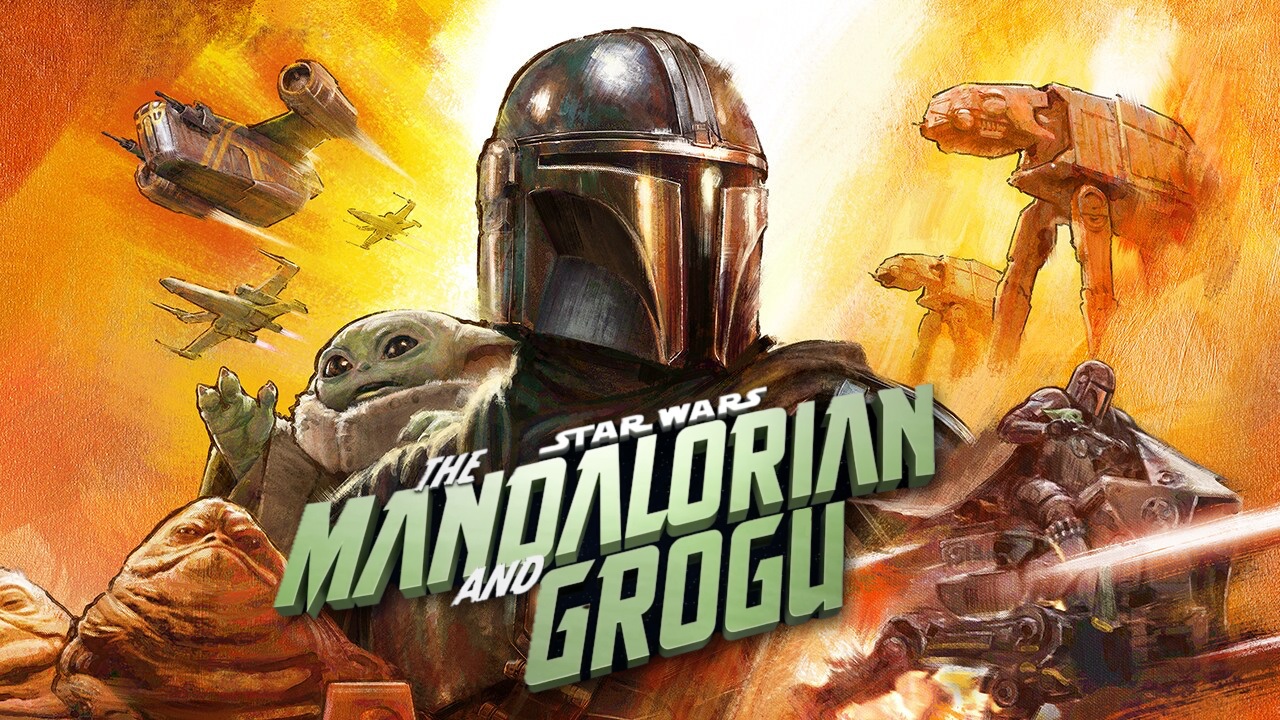
The Mandalorian & Grogu hits theaters May 22nd and the trailer is packed with secrets. Full breakdown of the new Razor Crest, Martin Scorsese's cameo, Nar Shaddaa, Grogu's destiny, and why this film feels like the Star Wars we grew up with.
Seven years.
That is how long it has been since a Star Wars film played in a cinema. Seven years of television, of streaming, of deeply divided fandom arguments — and then that trailer dropped, and somehow, in about two and a half minutes, most of that noise just went quiet.
Something about the first shot — X-Wings cutting across a hazy orange sky, the horizon sitting low, the scale of everything feeling enormous and lived-in — made it feel less like a marketing asset and more like a genuine homecoming. If you found yourself unexpectedly emotional watching it, you were not alone, and you were not being dramatic.
But there is a lot packed into this footage beyond the emotional gut-punch of the opening. There are deep-cut lore references that casual viewers will miss entirely. There is a casting choice so unexpected it briefly broke the internet. There is a piece of hardware making a return that matters more than it probably should. And underneath all of it, there is a genuinely moving story about a man trying to be a good father to a creature that is going to outlive him by centuries.
Let's go through all of it properly.

The Opening Shot — Why That Sunset Is Not Just Pretty Cinematography
The trailer opens with X-Wings silhouetted against a warm, hazy, amber sky. It is a beautiful image. It is also a very deliberate one.
Director Jon Favreau and the team behind this film grew up on the same cinematic language that shaped the original trilogy — the Spielberg philosophy of keeping the horizon low, making the world feel infinite, and letting the audience sense scale before the story even begins. That specific visual grammar — small figures or vehicles against an enormous sky — is the same language used in E.T., in the John Ford westerns that directly inspired George Lucas, in the classic adventure films that made audiences feel like children regardless of their age.
It is not coincidental that the first image this trailer chooses is one that communicates, before a single word of dialogue, that this is a big story told on a human scale. Mando and Grogu are tiny against that sky. The galaxy they move through is vast and dangerous and old. And yet the story is fundamentally intimate.
That tension — small people navigating enormous stakes — is what made The Mandalorian work as a television series and what gives this theatrical version its best chance of working as a film.

The New Razor Crest — Why This Matters More Than It Looks
The N-1 Starfighter that Din Djarin flew through the later seasons of The Mandalorian was, objectively, a beautiful piece of spacecraft design. Sleek, fast, visually distinctive. A hot rod in space.
But a hot rod is not a home. And that distinction turns out to be significant.
The trailer reveals what appears to be a new Razor Crest — a pre-Empire assault ship with a yellow-trimmed paint job that carries obvious design DNA from the original vessel destroyed in Season 2. The choice is worth thinking about beyond simple nostalgia for the lost ship.
The original Razor Crest had a carbonite chamber. It had storage. It had space — literal and figurative — for a life to be lived aboard it. It was a vessel built for someone who does not stay in one place but still needs somewhere to call home. The N-1 was a fighter. The Razor Crest is a dwelling.
Mando choosing to return to this kind of ship signals something about where he is in his arc. He is not operating primarily as a soldier or a bounty hunter anymore. He is a father. He needs a place where Grogu can sleep, where supplies can be stored, where two people can exist together between missions. The yellow paint — possibly with faint Huttese cultural references embedded in the design — suggests someone adapting to the world he actually navigates now rather than the one he used to.
It is a small detail that carries a lot of weight about character evolution, which is exactly the kind of thing this franchise has always done best when it is operating at its peak.

Martin Scorsese Is in This Film — And That Is More Meaningful Than It Sounds
Let's address the moment the internet collectively lost its mind.
Martin Scorsese — director of Goodfellas, Taxi Driver, The Departed, one of the most significant filmmakers in cinema history — appears in the trailer as a six-limbed alien food vendor named Hugo. His stall appears to be selling something called "Flat Meat Frys" alongside what looks unmistakably like a panini press, which is a deeply specific callback to Jon Favreau's earlier film Chef.
The surface reading is that it is a fun cameo. The deeper reading is more interesting.
Scorsese has been, for several years now, one of the most prominent voices arguing that Marvel and franchise blockbusters represent a kind of creative diminishment of cinema — "theme park movies" was his phrasing, and it generated enormous debate across the industry. That conversation has never fully gone away.
Having Scorsese appear in what is arguably the flagship franchise of modern blockbuster filmmaking — willingly, visibly, in a role that requires substantial prosthetics — reads as something. A peace offering between different philosophies of what film can be. An acknowledgment that the division between "serious cinema" and "popular entertainment" has always been somewhat artificially constructed. A joke that both parties are in on.
Whatever the intent, it is the kind of casting choice that only happens when the people making the film have enough confidence in what they are building to invite that level of scrutiny. It also gives film critics something to write about for months, which is never a bad thing for a film's cultural footprint.

Nar Shaddaa — A Deep-Cut Location Finally Getting Its Due
For those who grew up on the Star Wars Expanded Universe novels and video games from the 1990s and early 2000s, the appearance of Nar Shaddaa in live-action is genuinely significant.
Known as the Smuggler's Moon — a massive, densely developed satellite orbiting Nal Hutta, the Hutt homeworld — Nar Shaddaa has existed in Star Wars lore for decades as the franchise's answer to the kind of neon-drenched, morally absent underworld cityscape that Blade Runner made iconic. Every surface covered in competing signage. Every alley a transaction waiting to happen. The kind of place where the distinction between a war criminal and a legitimate businessperson is largely one of paperwork.
It appeared in the original Shadows of the Empire novel, in multiple beloved video games, in comics. Longtime fans have been waiting to see it rendered properly in live-action for a long time. The trailer suggests the production has done the location genuine justice — it looks layered, textured, genuinely alien in a way that feels earned rather than cosmetic.
The choice of location also makes narrative sense. If the story involves Mando and Grogu navigating Imperial Remnant activity and Hutt criminal networks simultaneously — both of which the trailer gestures toward — Nar Shaddaa is exactly the kind of environment where those two worlds collide most naturally and most dangerously.

The Hutts Are Back — And the Political Landscape Is Complicated
The trailer confirms the return of Hutt cartel activity, with the Twins from The Book of Boba Fett apparently reasserting their position in the post-Empire power structure. Meanwhile, the Imperial Remnant continues operating in the shadows, the familiar phrase "Long live the Empire" surfacing in what sounds like a quiet, persistent ideological undercurrent rather than an organized military threat.
This dual-front pressure is smart storytelling structure for a film. Mando and Grogu are not just facing one enemy with one motivation. They are navigating a political landscape where multiple factions are competing to fill the power vacuum left by the Empire's collapse — and where the New Republic, however well-intentioned, is not yet strong or organized enough to hold everything together.
That is a world that rewards complexity. It is also a world where the choices individual characters make carry real consequences, because there is no dominant power enforcing stability. Every alliance is provisional. Every deal has a catch. Every location is contested.
It gives the film room to be genuinely tense in a way that some of the more recent Star Wars content has struggled to achieve.

Sigourney Weaver as Colonel Ward — The Mission Structure Gets Serious
Sigourney Weaver appears in the trailer as Colonel Ward, a New Republic officer who hands Mando what is described as a "Deck of Warlords" — a set of Sabacc cards apparently repurposed to function as a most-wanted list for the Republic's most dangerous remaining threats.
The casting alone is a statement. Weaver has spent forty-plus years playing women in positions of authority in high-stakes science fiction — she understands how to deliver exposition and mission parameters in a way that feels like genuine command rather than plot delivery. Giving her a role that essentially frames Mando's objectives for the film is a smart piece of structural casting.
The Deck of Warlords concept is also a clean, visually memorable storytelling device. Rather than a complex bureaucratic briefing about geopolitical threats, you have a physical object — a deck of cards, each representing a face and a name and a level of danger. It is tactile and specific, which makes the mission feel real in the way that abstract political summaries rarely do.
It also gives the film a natural episodic quality without feeling like a collection of television episodes. Work through the deck. Each card is a problem. Some problems connect to larger problems. By the time the deck runs out, you understand the world.

Embo Returns — And Yes, The Hat Is Still a Weapon
For the dedicated corner of the fandom that has been waiting fifteen years for this: Embo is back, and the hat-shield is confirmed operational.
For the uninitiated — Embo is a Kyuzo bounty hunter who appeared in Star Wars: The Clone Wars, one of the most beloved characters in the animated series, known for an extraordinarily distinctive fighting style that involves throwing his wide-brimmed hat as a ranged weapon, using it as a shield, riding it as a sled, and generally demonstrating that headwear can be far more versatile than most people give it credit for.
His appearance in live-action is the kind of deep-cut fan service that works precisely because it is earned. It is not a cameo designed to generate a clip. It is a character who has been developed across years of storytelling, finally crossing into the medium where the larger audience lives. For people who watched The Clone Wars, it is a genuine payoff. For people who did not, he is a visually striking and unusual presence who does not require backstory to be immediately interesting.
That is how you handle legacy characters well. Make them serve the story while rewarding the people who did the extra homework.

Grogu's Destiny — The Line That Hits Hardest
Everything in the trailer is building toward one moment, one piece of dialogue that reframes the entire emotional weight of everything we have watched over five-plus years of The Mandalorian.
Grogu will live "centuries beyond me."
Din Djarin says this, or it is said about their situation, with a quiet acceptance that makes it land harder than any action sequence could. He knows. He has always known, on some level — Grogu is fifty years old and was barely out of infancy when they met. The mathematics of their relationship have always had this endpoint written into them.
And yet he is teaching him the Way. He is raising him as a Mandalorian, giving him a culture and a code and an identity, knowing that Grogu will carry all of it long after Din is gone. The trailer shows Grogu deploying whistling bird rockets — tiny guided munitions fired from his little wrist gauntlet — with the Beskar chainmail peeking out from beneath his robes. He is armed. He is trained. He is, in the most meaningful sense, his father's son.
This is where the film's emotional argument lives. Din Djarin is not trying to protect Grogu from the galaxy forever — that is impossible, and he knows it. He is trying to give Grogu everything he needs to survive it. That is what good parenting actually looks like, in a galaxy far away or anywhere else.
Grogu had a choice in Season 2 — Luke Skywalker's training and the Jedi path, or Din and the Mandalorian way. He chose Din. Not power, not tradition, not destiny. He chose his person. Understanding the full weight of what that choice cost him and what it gave him is what the film needs to make tangible.

The Bittersweet Context — We Know What Happens Next
There is a particular kind of emotional complexity that comes from watching characters fight for something you know they will not fully achieve.
We know, from the sequel trilogy that takes place decades later, that the New Republic fails. The First Order rises. The galaxy falls back into darkness and conflict before climbing out again. The institutional future that Mando and Grogu and Colonel Ward are trying to build in this film does not hold.
But that knowledge makes the present-tense story more meaningful, not less. The characters do not know what we know. They are fighting as hard as they can for a future they genuinely believe is possible. Their hope is not naive — it is the only rational response to the circumstances they are in.
Star Wars has always been, at its core, about how people maintain the capacity for hope in a universe that gives them plenty of reasons to abandon it. The original trilogy is literally about a small group of people fighting an empire that controls everything. The Mandalorian is about a man who has lost his people, his culture, and his purpose finding all three again in the company of a small green creature with enormous ears.
This film is about what you do with the time you have, knowing the time is limited, knowing the struggle continues past you.
That is not a theme park ride. That is a story worth telling on the biggest screen available.
What to Watch For When the Film Releases
If you want to go in with your attention calibrated correctly:
- Watch the political background carefully. The Hutt and Imperial Remnant dynamics are not just set dressing — they are going to create the specific pressures that force Mando and Grogu into their most difficult decisions.
- Pay attention to Grogu's independent choices. He is not a baby anymore, narratively. The trailer suggests he has his own agency and his own combat capabilities. Moments where he acts without being directed are the story's way of showing you who he is becoming.
- The Deck of Warlords is probably a structural device. Each card likely represents a set piece or a location. The deck running out is probably when the film's final act begins.
- Scorsese's food vendor scene is worth watching for background details. The Chef panini press reference is clearly intentional — there may be other production in-jokes embedded in Hugo's stall.
FAQ: The Mandalorian & Grogu Film
When does The Mandalorian & Grogu release in theaters? May 22nd, 2026. It will be a full theatrical release — not a streaming premiere.
Is this a continuation of The Mandalorian series or a separate story? It is a direct continuation, following the events of the television series. Familiarity with Seasons 1 through 3 and The Book of Boba Fett is recommended but the film appears to be structured accessibly for new audiences.
Why is there a new Razor Crest? The original Razor Crest was destroyed at the end of Season 2. The vessel in the trailer is a new ship of the same class, suggesting Din has returned to the practical, home-capable spacecraft category rather than the smaller N-1 Starfighter he flew in later seasons.
Who is Embo and why do fans care so much about him? Embo is a fan-favorite bounty hunter from Star Wars: The Clone Wars animated series. His distinctive hat-based fighting style and visual design made him one of the most memorable characters in the show. His appearance in live-action is a significant moment for fans of the animated era.
What is the Deck of Warlords? Based on the trailer, it appears to be a New Republic intelligence asset — Sabacc cards repurposed as a most-wanted list for dangerous post-Empire threats. Sigourney Weaver's character Colonel Ward presents it to Mando as the framework for his mission.
Will this connect to the sequel trilogy timeline? The film is set in the same post-Return of the Jedi era as the television series, roughly a decade before The Force Awakens. Direct connections to the sequel trilogy events are unlikely, but the broader political context — the New Republic's struggle to maintain stability — runs parallel to the conditions that eventually allow the First Order to emerge.
Is Martin Scorsese really in this film? Yes. He plays a six-limbed alien food vendor named Hugo. It is not a rumor or a deepfake. He is genuinely in the film, which is an extraordinary sentence to type.
Final Thoughts
The most telling thing about the Mandalorian & Grogu trailer is not any single moment in it. It is the feeling the whole thing leaves behind.
Recent Star Wars content has occasionally felt like it was trying very hard to remind you that you love Star Wars — deploying familiar music, familiar faces, familiar imagery in ways that felt more like reassurance than storytelling. The gap between what the franchise used to make you feel and what it was currently making you feel was visible in the work.
This trailer does not feel like that. It feels like people who are genuinely excited about the specific story they are telling, and who trust that the specific story is enough — that it does not need to lean on legacy beyond what the legacy has legitimately earned.
Din Djarin and Grogu earned their place in Star Wars history across five seasons of television. The film is not asking you to remember why you used to love this. It is building on something it actually built.
Seven years between Star Wars films is a long time. If this is what the wait produced, it was probably worth it.
.png)


No comments:
Post a Comment