Description: Dive deep into the terrifying real-life stories behind The Conjuring 2. We explore the facts and fictions of the Enfield Poltergeist and the Amityville haunting, separating Hollywood scares from the complex truth.
Fact vs. Fiction: The Terrifying Real-Life Stories Behind The Conjuring 2
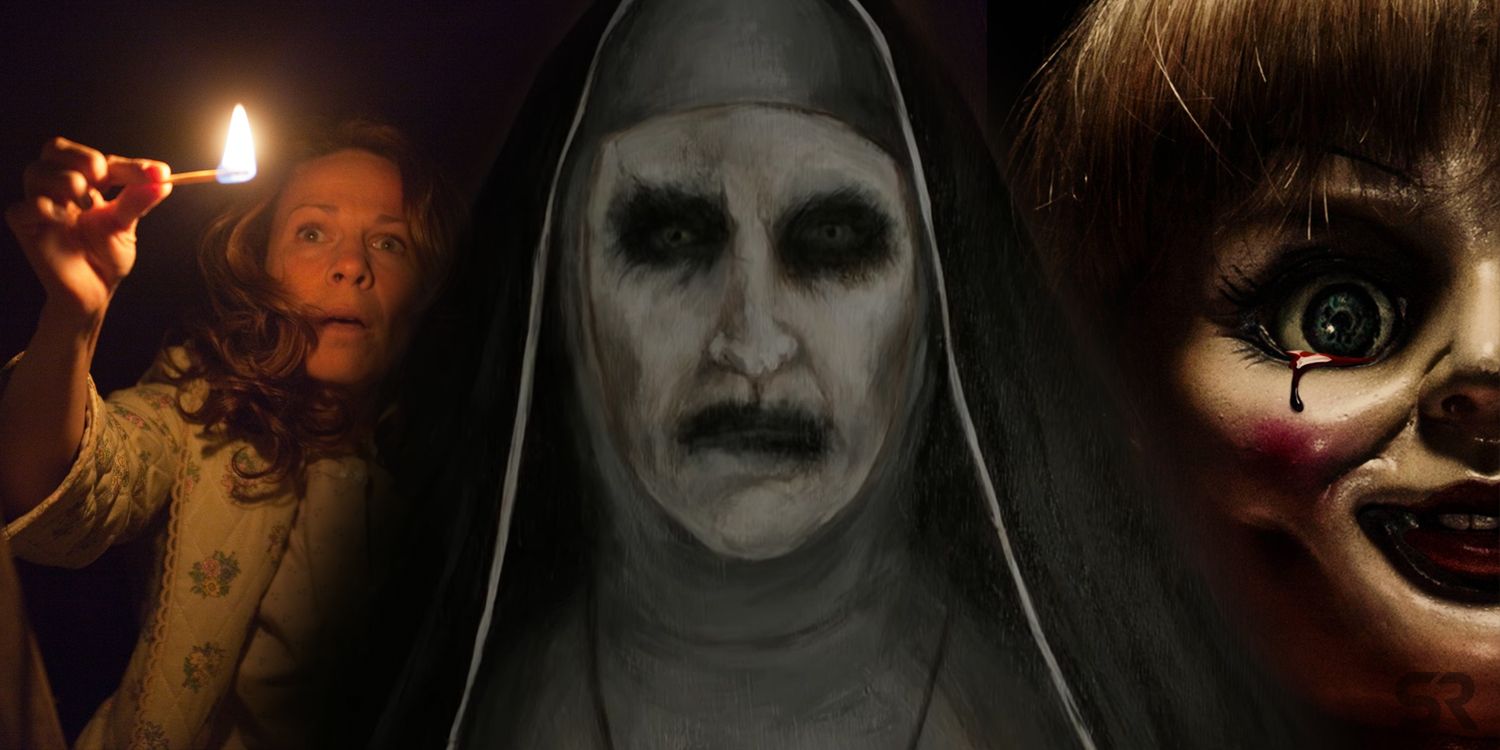
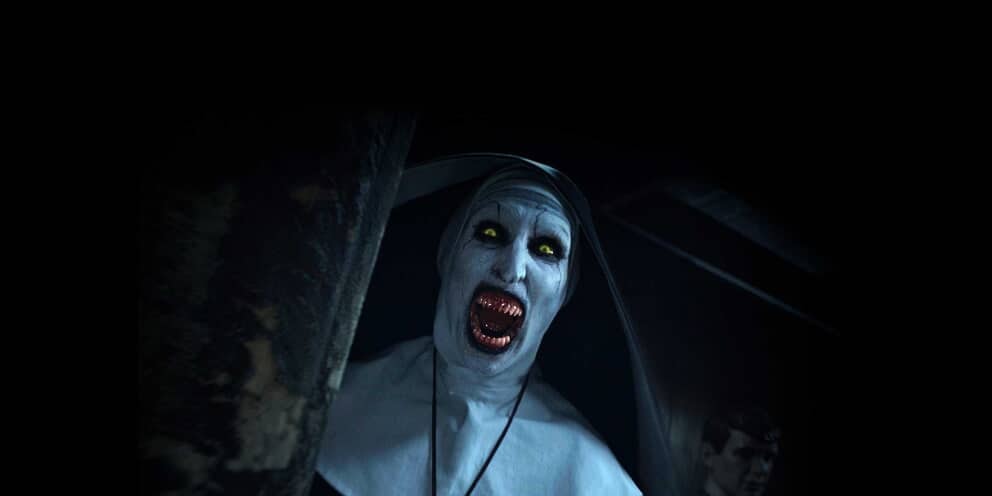
The Conjuring 2, based on the real events of the Enfield Poltergeist, once again follows famous demon hunters Ed and Lorraine Warren. The film joins them in 1977 as they travel to England to investigate the possession of 11-year-old Janet Hodgson. Tormented by the spirit of the house's previous owner, the Warrens soon discover something more demonic is going on. This sequel wasn't just a standalone horror film; it was a pivotal moment in cinema, solidifying the "Conjuring Universe" as a major franchise. It successfully introduced the demon Valak, whose terrifying nun form proved so popular it launched its own billion-dollar spin-off series.
Set in the town of Enfield, the haunting of the Hodgson family is one of the most famous cases of paranormal activity in the world, as well as one of the most documented. For many in the UK, the Enfield Poltergeist was a household name long before the film, a sensational story that played out in tabloids and on television. The story of Amityville, which also appears in the movie, is a case the Warrens investigated just three years prior. The film cleverly pairs these two titans of terror, both of which became famous due-in-large-part to their heavy "documentation"—a term that often means media saturation rather than verifiable, scientific evidence. With all the interviews, photos, and video footage of the real events, many elements in this film come directly from the accounts of those involved, which the filmmakers use to blur the line between reality and blockbuster horror.
In this article, we'll explore the film's narrative, the real-world facts surrounding these complex cases, and all the hidden details within the movie—including all the times the main villain's name appears in the background.
:max_bytes(150000):strip_icc():focal(399x0:401x2)/janet-hodgson-800-0a7b66b7eb5b4b55ac82cd4644f476e2.jpg)
The Amityville Opener: A Familiar Haunting
The movie kicks off at the instantly recognizable Amityville house. The film's cinematography lingers on those iconic, eye-like windows, giving the house a personality of its own—an evil, watchful face. This has turned it into the most widely known haunted house on earth, and its ominous appearance is a key reason the story captured the public's imagination. This case kickstarted a modern resurgence in interest around the paranormal, and it's the perfect place for the film to begin, immediately grounding the audience in a haunting they already know and fear.
We start with Ed and Lorraine investigating the famous haunting and murder, taking place in 1974. The Amityville haunting began when Ronald DeFeo Jr. killed his family. A year after the murders, a new family, the Lutzes, moved into the house and claimed to have been terrorized by ghosts. This led to them moving out just 28 days later. The story quickly became the most famous haunting of all time, spawning numerous books, television specials, and over 20 different movies. The Amityville stories somewhat created a blueprint for modern hauntings, establishing tropes we now take for granted: the 28-day cycle, the house with a dark past, the escalating phenomena from cold spots to full-blown demonic oppression, the family fleeing in terror, and the ensuing media circus.
Fact-Checking the Amityville Case
The real Amityville haunting, however, has been disputed for a number of different reasons. With so much publicity, the case faced intense scrutiny, and every detail was questioned. This reached the point that the family was involved in a lawsuit with the house's new owners over the publicity. Most damningly, Ronald DeFeo Jr.'s own lawyer, William Weber, later claimed that he, along with the Lutzes, "created" the horror story "over many bottles of wine," seeing it as a lucrative book and movie deal.
The involvement of the Warrens in the case is also highly embellished in the film. They only came to the house after the Lutzes had left, at the invitation of a local Channel 5 news crew, not the church, as Lorraine claims in the film. The Warrens never even met the Lutz family, but their involvement with the television segment cemented their reputation as paranormal investigators. This gave them their claim to fame and made them the most famous on earth.
The film shows Lorraine conducting a seance in the house for TV, as well as the famous photo of a supposed ghost boy from their investigation. That photo, allegedly taken by an automatic camera, is a cornerstone of the Amityville legend, but it's easily debunked; the "boy" bears a striking resemblance to Paul Bartz, a member of the investigation team who was present in the house that day. He appears in the film to show Lorraine the secrets of the house, though most believe the photo was just a member of the crew.
In the film, Lorraine has a vision of herself committing the murders in Ronald DeFeo's place and hears the demon voices DeFeo claimed haunted him. This was also contested; claims that DeFeo heard voices weren't in his original defense plea and only seemed to appear after the Lutz's story gained traction.
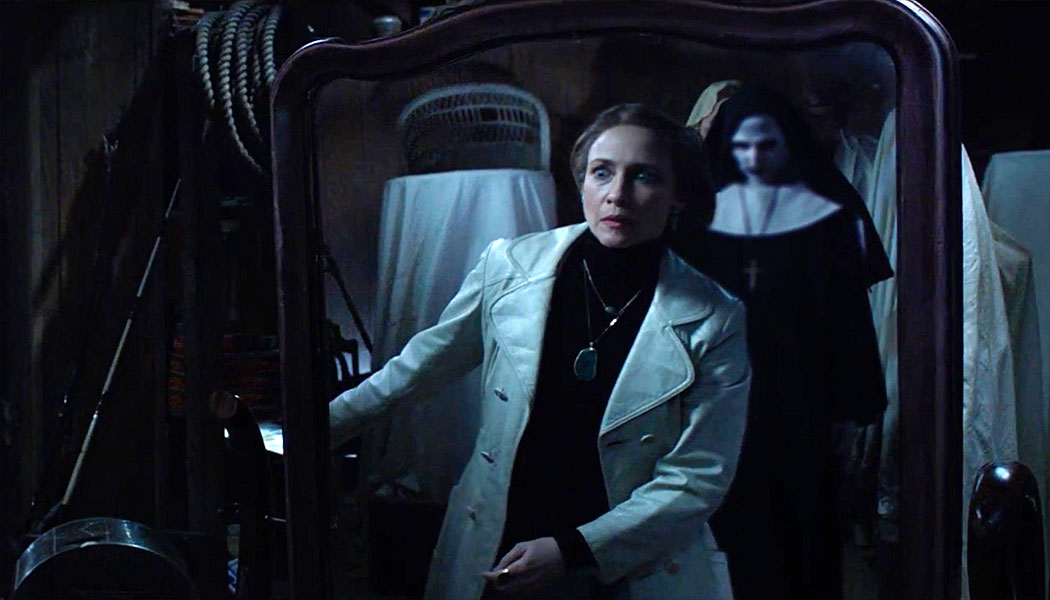
After her vision, Lorraine sees the ghost boy and follows him to the basement. It's here that the nun, the film's main antagonist, makes her first appearance. The nun is actually teased earlier, at the 3-minute 45-second mark, in a picture. Popping up in the mirror, the nun immediately starts choking Lorraine, instantly establishing her as a powerful threat. This is a crucial, and fictional, addition. The nun (Valak) had no connection to the real Amityville or Enfield cases. She was added to the film to create a unifying villain, a demonic puppet-master connecting the Warrens' past to their new case. Lorraine then sees a vision of Ed's death, which hangs over the franchise. Lorraine tells Ed that the house is "the closest to hell she ever wants to get," which is an actual quote from the real Lorraine Warren, said to TV anchor Marvin Scott, who, ironically, later stated he spent hours in the house and experienced absolutely nothing.

Welcome to Enfield: Meet the Hodgsons
The film then takes us across the pond to Enfield, depicted with a dreary, blue-ish filter that makes 70s England feel perpetually cold and miserable. This visual choice starkly contrasts the warm tones of the Warrens' American home and immediately establishes an atmosphere of depression and decay. We meet the Hodgson family: Janet, her older sister Margaret, younger brother Johnny, and the baby of the family, Billy. We see the kids are close; Janet gets caught with a cigarette, and the teacher takes a drag after the kids leave—a real "70s England" moment that efficiently sets the scene.
The kids are all based on the real-life Hodgson kids, but Johnny is barely featured. During the real hauntings, it was mainly Janet and Margaret who had the most experiences. Johnny unfortunately died of cancer at the age of 14, shortly after the poltergeist events. His tragic passing is most likely why he's not heavily featured in the movie, which respectfully shifts the focus to the female-centric household.
As the kids enter the house, we meet their mum, Peggy. We learn the Hodgsons aren't doing well financially, and their dad isn't in the picture, having left after having twins with a neighbor. This detail is crucial. In real life, it was known they had money difficulties, and Peggy was actively looking for a new house. Skeptics point to this as a powerful motive. A family in such dire straits, living in a run-down council house, might (consciously or subconsciously) welcome the media attention, the gifts from reporters, and the potential for financial gain or, at the very least, being rehoused by the council. The film acknowledges this but quickly dismisses it to focus on the supernatural.
The Haunting Begins: Ouija Boards and Knocking
That night, we get our first play of the "Crooked Man" song from a creepy zoetrope toy. As Margaret goes into her and Janet's room, she finds her sister with a Ouija board, apparently made at school. The girls try to use the board to ask about their dad coming back, but nothing happens. They then ask if there are any spirits that want to communicate, basically inviting them in. This functions as the film's clear-cut "inciting incident," a common horror trope where the victims personally invite the evil in.
However, this incident with the board is a bit hazy in real life. The older sister, Margaret, claimed she played with one four years earlier and saw a ghost, which she then reported seeing in the Enfield house. But this contradicts other reports. Morris Gross, one of the main investigators, stated on a radio program that none of the Hodgsons had been involved with activities like using a Ouija board. The other main investigator, Guy Playfair, stated in his book that Peggy was very afraid of these boards. The film's choice to include it provides a simple, dramatic explanation for the haunting's origin, which the real case lacks.
Although they didn't get answers from the board, they soon find out someone was listening. Janet has her first encounter, seemingly teleporting from her bed to the living room. Margaret is woken by a loud, percussive knocking, but no one is there. This scene is a loose adaptation of what the girls reported happening at the start of the haunting. According to the Hodgson family, the hauntings began when Janet and Johnny tried to convince their mother that the beds were shaking uncontrollably. Then, knocking started, and drawers began sliding open. The film captures this escalation well, starting with simple, unsettling noises and building to impossible events.

The Warrens' Involvement: Fame and Skepticism
We meet back up with Ed and Lorraine on a TV show, debating a skeptic. This scene seems to be recreating the Warrens' appearance on the Sally Jessie Raphael Show in 1992, where they debated skeptic Joe Nickell. However, that was related to a different case (the Snedekers in Connecticut, which inspired The Haunting in Connecticut). The film paints Ed as a paranormal badass and the skeptic as a nerd. In reality, Joe Nickell was a renowned paranormal debunker who wrote for the Skeptical Inquirer and challenged almost everything supernatural. These real-life debates were far more contentious, with skeptics like Nickell presenting well-reasoned, scientific-based arguments, which the Warrens often deflected with appeals to faith or by simply talking over them.
Back in Enfield, Margaret is woken up by Janet talking in a super creepy voice, saying it's "his house." We then get the big, scary tent scene. Peggy is called to investigate and finds Janet in the rocking chair in the living room. Peggy brings Janet upstairs, but the chair continues to rock. These are classic, effective haunting scares. The next day, Janet is further terrorized by the ghost, who keeps changing the TV channels. She finds the remote on the same chair she was found in, and then sees the ghost's reflection in the TV, screaming "MY HOUSE!" This is a brilliant bit of cinematic storytelling—it’s not just a random scare, but an intelligent, taunting presence that's one step ahead. The chair and the remote become key pieces of foreshadowing.

Bill Wilkins: The Voice of the Poltergeist?
After the dresser slides across the room and locks the family in, they flee to the neighbors' house across the street. This is close to what really happened; Peggy called the police in August 1977 after the kids claimed furniture was moving. The neighbors, Peggy Nottingham and her husband, were key witnesses.
The police arrive, and this is where the film uses a classic horror trope: the police are useless. However, they do witness the chair move across the room and promptly leave, filing a report. This actually happened, and it's perhaps the single most important event in the entire case. Officer Caroline Heaps gave an official statement: "I then saw the chair slide across the floor moving approximately 3-4 feet... I checked the chair but could find nothing to explain how it had moved." This police statement is what legitimized the story. It was no longer just a single-mother's "hysteria"—it was an externally-validated, official report from officers of the law. This is the moment that launched the case into the national media spotlight.
This brings media attention. A TV reporter, Kent Allen, approaches Peggy, and we cut to a television special. Here, photographer Graham Morris describes running into the house to see Lego bricks flying around, with one hitting him in the face. This special seems to be a mix of sources, but it's mainly based on a 1977 BBC special. In real life, it was Peggy who reached out to the Daily Mirror after the police incident. The Daily Mirror had a history of fabricating ghost stories, which casts some doubt. The Lego incident is also when Morris took the infamous photo of Janet "levitating," which skeptics have long argued is simply her jumping on the bed.
This is also where we're introduced to Maurice Gross, one of the main investigators of the case. Gross was a member of the Society for Psychical Research (SPR). He joined the group after his daughter, also named Janet, was sadly killed in a car accident. This began his obsession with the paranormal, hoping to find answers. This personal tragedy is a massive psychological component. It's highly likely Gross was operating from a place of intense confirmation bias; he wanted to believe in an afterlife, perhaps to find comfort that his daughter was somewhere safe. This, coupled with his grief, is likely why he became so committed to the Enfield case and made him a perfect, if sympathetic, mark for what may have been elaborate pranks. Gross has been criticized for his willingness to take Janet's claims at face value, even to the point of being naive.
We are also introduced to Anita Gregory, a fellow member of the SPR. She is depicted as a skeptic there to spoil the fun. Both Gregory and the SPR president, John Beloff (who is left out of the film), concluded that the case was nothing more than children playing tricks.
Guy Lyon Playfair, the other primary investigator alongside Gross, is a major omission from the film. This exclusion is almost certainly deliberate. Playfair, who wrote the book This House is Haunted, was with Gross throughout the investigation. However, his account is far more balanced and complex. While Playfair maintained that he believed some of the activity was genuine, he was more level-headed and openly admitted to being fooled by the girls on multiple occasions. Including a character who was both a believer and a skeptic who caught the girls faking would have fatally undermined the film's "this is a 100% true story" narrative.
During an interview, Janet, seemingly possessed, begins barking and growling. She then starts talking in the voice of an old man: Bill Wilkins. Through Janet, Bill says he's 72 years old and died of a brain hemorrhage in the living room chair. This is based on one of the most famous instances of Janet talking in Bill's voice from the same BBC interview, though much of the dialogue comes from tape recordings by Gross and Playfair. However, the investigators were rarely in the room when Bill "spoke," as he typically didn't perform in front of prying eyes. Skeptics at the time pointed out that Janet was likely using her "false vocal folds," a ventriloquism technique, to produce the gravelly voice. Playfair also admitted that Bill had a habit of suddenly changing topics, a trait Janet also shared. It's also worth noting Bill wasn't the only spirit Janet claimed to be possessed by; there were others, including "Dirty Dick."
Uncovering the Real Bill Wilkins
While Bill gave a seemingly detailed description of his death, the biggest piece of "evidence" supposedly came from his son, who called into a radio show Gross was on and confirmed the details.
However, researchers later fact-checked this. Checking the electoral roll, a William C. and Ethel M. Wilkins owned the house from 1960 to 1964. Death certificates revealed that William Wilkins died at age 61 in June 1963 from a blood clot in the heart, not a brain hemorrhage. He was also buried in Lavender Hill Cemetery, over 3 miles away, not Durrance Park as the "ghost" claimed. This makes the "son's" confirmation highly suspect. Furthermore, the neighbors, the Nottinghams, had lived next door since 1960, meaning they would have definitely known the real Bill Wilkins and how he died. Their silence on the matter is deafening. It's incredibly strange they never thought to correct the record, suggesting either they were "in on it" to support their neighbors, or, more likely, the girls overheard details about the previous tenant from the Nottinghams and incorporated them into their story.
Valak: The Demon in the Painting
Back with the Warrens, Lorraine wakes up to find Ed painting the nun she saw in Amityville. This is when the film reveals its connections. Throughout the house, the demon's name is actually scattered all over. When Lorraine sits at the kitchen table, "VALAK" is spelled out in letters on the wall and in the windowsill. This is a brilliant piece of filmmaking, rewarding eagle-eyed viewers and repeat viewings. Their daughter, Judy, can also see the nun, and it's possible she was subconsciously putting up these letters.
Lorraine, remembering her vision of Ed's death, tells him she doesn't want to take on new cases. But the church calls them to action, sending them to Enfield.
This is where the film's timeline diverges sharply from reality. Playfair had harsh words for the Warrens, claiming they just "showed up one day uninvited" and caused "mayhem." He stated they only stayed for that one day (not three, as the film implies) and that Ed Warren told him he could "make lots of money" on the case.
Among the hundreds of tapes collected, the Warrens only come up twice and are never mentioned by the Hodgson family or neighbors. It seems their heroic role in the film was based on, or "stolen" from, another paranormal hunting couple, Annie and George Shaw. Playfair described the Shaws as a "very pleasant couple" who "firmly refused payment or publicity." Annie Shaw was a clairvoyant, like Lorraine, and her reading—determining a "black magic chap" and an "elemental" spirit—sounds an awful lot like how the nun is later revealed to be controlling Bill. The film needed the Warrens to be its heroes, so it seemingly took the actions of this modest, unpaid couple and attributed them to Ed and Lorraine, whose motives were questioned by the actual investigators.
It's also worth noting that the demon "Valak" is a real figure from occult lore, but the film's depiction is pure invention. In grimoires like The Lesser Key of Solomon, Valak (or Valac) is described not as a nun, but as a small child with angel wings who rides a two-headed dragon, commands 30 legions of demons, and finds hidden treasures. The terrifying nun was a creative choice, reportedly added in reshoots because it played on themes of perverted faith.

The Crooked Man: A Nightmare Nursery Rhyme
One of the film's most terrifying sequences involves the Crooked Man. Billy wakes up to the sound of the dog's bell, which was set up during their first visit to the Nottinghams. He goes to see "who let the dogs out," but the figure suddenly morphs into the Crooked Man and chases him down the hall.
The dog twisting itself into the Crooked Man is incredibly disturbing, and the way he stomps after Billy reciting the song is terrifying. It almost looks like stop-motion animation, giving it an uncanny, otherworldly feel. This character's inclusion serves a few purposes: it adds variety to the scares, it gives Billy (a mostly background character) a personal tormentor, and it served as a blatant attempt to set up another spin-off film (which was later cancelled). It's a clear example of franchise-building at work.
Billy wakes everyone up, and they all hear the Crooked Man, only to find it's Janet channeling him before she has a seizure.
The Film's Climax vs. The Real Story
Ed and Lorraine arrive at the Hodgson house and test Janet for faking by having her hold water in her mouth. Bill refuses to speak unless everyone turns away. This was an actual experiment Gross and Playfair conducted, though they also taped her mouth shut.
Bill finally comes out to play, and in a fantastic one-shot scene, Janet blurs and morphs into Bill in the background. Ed asks why he doesn't move on, and Bill says, "I am not a heaven man." This line comes directly from a real session with Gross and Playfair. Playfair, however, believed the spirit of Bill sounded "lost and confused," not evil, a nuance the film ignores for a more sinister portrayal.
The film's climax involves Janet being choked by a curtain (which she claimed happened in real life, witnessed by the two Peggys), all the crosses turning upside down, and Ed and Lorraine battling the demon Valak. Anita Gregory, the skeptic, is used as a plot device; she "catches" Janet faking on video, causing the Warrens to leave. Janet later admits she faked it because the "ghost" wanted everyone to leave.
Ed, on the train, has a "eureka" moment, putting two tapes together to reveal Bill's full message: "Help... it won't let me go." This is pure Hollywood. It's a visually clever, cinematic beat that makes no logical sense but feels smart, giving the heroes the clue they need. Lorraine then has a vision where Bill tells her he can't leave because "IT" (Valak) wants Janet. This neatly recasts Bill as a fellow victim, revealing the nun has been controlling him all along.
They rush back to the house for the final showdown. Ed gets locked in the flooded basement, and Lorraine, remembering she scrawled the demon's name in her bible earlier, realizes the demon's name is Valak. Lightning strikes a tree, Ed is in peril, and Lorraine claims dominion over the demon by saying its name. This use of a "true name" to defeat a demon is a classic exorcism trope, giving Lorraine her powerful, definitive hero moment and concluding the supernatural battle the real case never had.
Final Verdict: What Really Happened at Enfield?
The film ends with a "where are they now" vignette, explaining that Peggy lived the rest of her days in the house, dying in the same chair that Bill did. (As we've established, Bill didn't die in that chair). The family who moved in afterward, the Bennets, also reported feeling uncomfortable and hearing voices, moving out after two months.
So, what's the real story? It's all very complex. Both Janet and Margaret admitted to faking things on multiple occasions. They once told a reporter they had been faking the voices all along to keep the case going (though they later retracted this). Later, Janet admitted she did fake "about 2%" of the phenomenon because sometimes things wouldn't happen, and she didn't want people to be skeptical. This admission is telling. As skeptics often point out, if you're caught faking once, your credibility on all other points is compromised. Why would a genuine, powerful poltergeist need "help" from a child moving a spoon?
Perhaps the most telling breaks in the case come from Janet herself. Under hypnosis, she reportedly admitted she and Margaret faked the whole thing. And in another famous TV interview, when the interviewer asks why they think their house is haunted, Janet says, "It's not haunted," to which Margaret starts laughing and punches her, telling her to shut up. It's an unguarded, startlingly human moment where the performance seems to drop completely.
The Conjuring 2 is a lengthy, effective horror film with some truly great setups and satisfying payoffs. But in reality, the people actually involved in the case, like Maurice Gross and Guy Playfair, were largely shafted. The film creates another narrative for the Warrens, who, by most accounts, had very little to do with the real-life case. The true Enfield story is a compelling one, but it's about a media-savvy family, a grieving investigator, a story that got out of control, and childhood trickery. The film had to ignore this messy, complex, and all-too-human story to tell a clean, terrifying, and supernatural one. And in that story, it had to cast the Warrens—who were barely there—as the central heroes. That is the biggest fiction of all.


No comments:
Post a Comment