
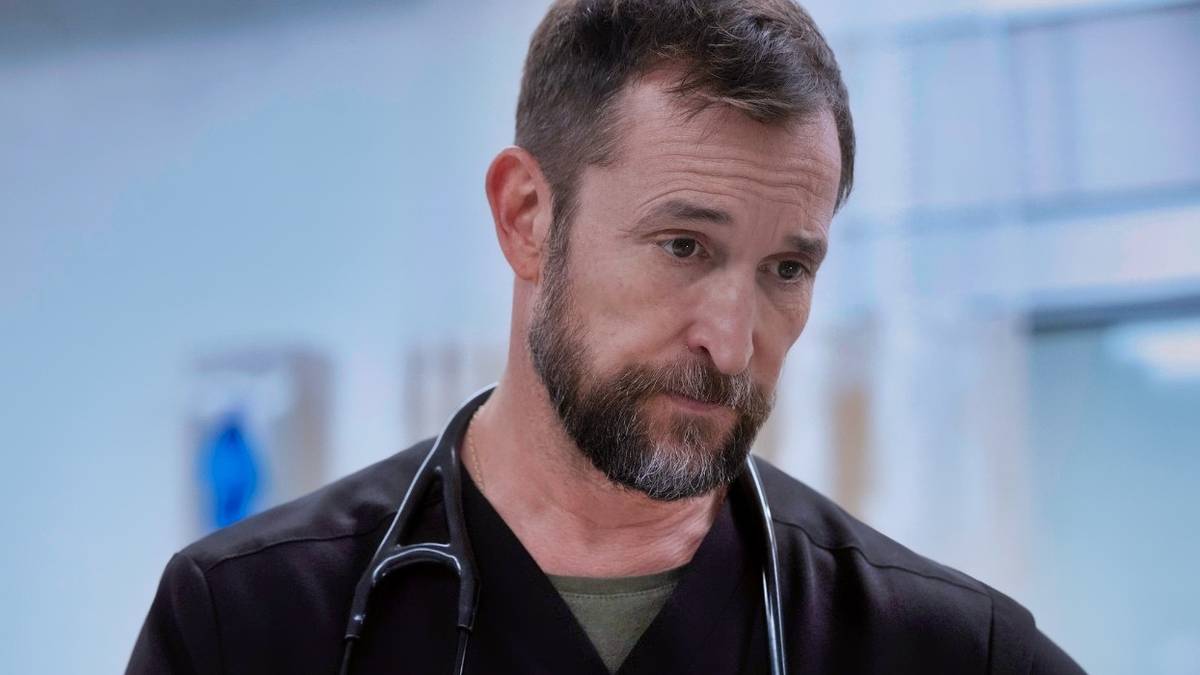
The Pitt Season 2 Episode 3 is the season's most emotionally devastating hour — three parallel relationship storylines, a wrongly accused father, a Tree of Life tribute, and a Code Black cliffhanger. Full breakdown inside.
Is everyone okay? Because I am genuinely not.
Hour three of The Pitt's July 4th shift just did something that the best episodes of this show do — it disguised an emotionally brutal character study as a medical procedural and then hit you with the human stuff when your guard was down.
This was not a standard "intense ER episode." This was Noah Wyle writing his own characters from the inside out, Uta Briesewitz directing hallways that somehow feel both claustrophobic and enormous simultaneously, and three parallel relationship storylines that collectively constitute an argument about what it costs to leave things unsaid.
By the time the episode's final beat landed — the Code Black declaration, the ER closing, Robbie's motorcycle sabbatical evaporating in real time — I had already been emotionally worked over by a ruptured spleen, a brain tumor that explained a divorce, and a scene involving a Pittsburgh samovar and fireworks that quietly became the most moving sequence of the season.
Let us go through all of it.
Direction and Writing — Why This Episode Feels Different
Before getting into the cases and the characters, it is worth pausing on the craft behind this episode, because both the direction and the writing are doing things worth naming.
Uta Briesewitz has a specific skill that viewers of Severance, Stranger Things, and Black Mirror will recognize immediately: she makes ordinary institutional spaces feel slightly wrong. Not obviously threatening — just subtly off in a way that keeps your nervous system on low-level alert throughout. The Westbridge ER hallways in her hands are simultaneously too narrow and too exposed. Crowded scenes feel like they are about to collapse inward. Empty corridors feel watched.
For a medical drama that depends on the audience feeling the pressure of the environment before any single dramatic moment arrives, this is invaluable. You are already tense before the first complication. By the time things actually go wrong, the tension has been building for so long that the release is almost physical.
Noah Wyle wrote this episode himself — his third for the series — and what that means in practice is visible in every character scene. An actor who has inhabited a role long enough to write it understands the silences as much as the dialogue. He knows what Robbie does not say better than any outside writer could, and the episode is full of those loaded absences. Robbie not trusting Dr. Al-Hashimi. Robbie not acknowledging that his reluctance is fear rather than competence. Robbie not being able to say the things that three separate patients spend this episode desperately wishing they had said to the people they love.
The parallel is not subtle. It is not trying to be.
Robbie and Dr. Al-Hashimi — The Torch That Is Not Being Passed
The Jackson Davis case — a college student tased by a campus security guard and brought in presenting with what the guard is absolutely certain is drug-induced psychosis — functions primarily as a pressure cooker for the Robbie and Al-Hashimi dynamic that has been building all season.
These are two doctors who represent opposite ends of a legitimate philosophical spectrum that exists in actual emergency medicine. Robbie operates on clinical intuition and is willing to bend protocol when his gut tells him a patient needs something the rulebook does not currently authorize. Al-Hashimi operates from evidence-based protocol and prioritizes the institutional safety structures that exist for genuinely good reasons.
Neither approach is wrong. Both approaches save lives and occasionally cause harm. The tension between them is not a story about who is right — it is a story about a man who is supposed to be leaving and cannot stop acting like he is staying.
Robbie's motorcycle sabbatical is not just a vacation. It is, or is supposed to be, an acknowledgment that the department needs to function without him — that the transition to Al-Hashimi's leadership needs to happen in practice rather than in theory. Every time he overrules her, he is delaying that transition. Every time he trusts his instincts over her protocols, he is implicitly communicating that he does not believe she is ready for decisions he has not personally blessed.
The episode is a portrait of a man who knows he needs to let go and cannot make himself do it. If you have watched anyone struggle with retirement, with handing off a business, with the specific grief of no longer being the most necessary person in a room — Robbie's behavior this episode is immediately recognizable.
He needs to start trusting her process not because her process is always right, but because his constant override is going to leave her with a department that has no muscle memory for operating without him.
Tony Chinchillo — Thirty Minutes of Satisfying Comeuppance
The campus security guard who tased Jackson Davis deserves his own section, because the writing around him is sharper than it might initially appear.
He presents as a recognizable type — the person with a small amount of institutional authority who has confused that authority with expertise, who uses confident professional-sounding language to describe observations that are entirely filtered through bias. He calls the campus library a "junkie jungle." He performs solidarity with the actual police officers in the room in a way that the actual police officers clearly find embarrassing. He is absolutely certain about what he witnessed, and his certainty has nothing to do with evidence.
The dry deflation of "uh, you're talking about the campus library" from the police officer is the episode's funniest line, delivered in the flattest possible tone, and it lands cleanly because the setup has been earning it for ten minutes.
The payoff when the toxicology screen comes back clean is where the comedy becomes something more uncomfortable. Chinchillo tased a college student having a mental health crisis in a library and is now sitting in the same ER facing the legal consequences of a decision made on nothing but bias and the confidence that bias generates when it is never challenged.
The episode does not belabor this. It lets the situation speak for itself and moves on. Which is the correct choice.
Three Couples, Three Stages of Crisis — The Episode's Emotional Core
Noah Wyle structured this episode around three parallel relationship storylines, each at a different stage of breakdown, each designed to illuminate something specific about what gets left unsaid between people who love each other.
The Yees — When the Wrong Person Is the One in Danger
Mark Yee comes in after a motorcycle crash. No helmet. The parallels to Robbie are immediate and the episode does not pretend otherwise.
The working diagnosis — potential spinal injury — resolves into something more manageable: Hypokalemic Periodic Paralysis, a condition involving the sudden muscle weakness triggered by changes in potassium levels. The relief of the diagnosis is genuine.
And then Nancy collapses.
She was the healthy one. The uninjured one. The one standing in the room supporting her husband while her own body was failing internally with a ruptured spleen. The person you least expected to be in danger was the one in danger the whole time, right there in the room, invisible because all the attention was pointed elsewhere.
The video apology Mark records with Dana's help — the one where he says he was wrong about everything he had been wrong about, addressed directly to Nancy — is the scene that broke most people watching. Not because it is theatrical. Because it is small and specific and true in the way that real apologies are true when the person making them finally understands what they are actually apologizing for.
The episode's argument in that scene is simple and devastating: you do not know which ordinary morning argument is the last conversation you will have with someone. The things left unsaid do not wait for you to find a better moment.
Benny and Kylie — When the Diagnosis Exonerates the Wrong Person
This storyline is the episode's most structurally sophisticated, because it requires the audience to examine their own pattern recognition alongside Dr. Santos.
Benny presents as a textbook case of what we have been conditioned to watch for — aggressive, defensive, controlling, escalating with security, fitting the profile of an abusive parent with uncomfortable precision. The bruising on Kylie. The way he positions himself between her and the medical staff. The explosiveness when questioned.
The diagnosis — ITP, Immune Thrombocytopenic Purpura, an autoimmune condition in which the immune system attacks the body's own platelets, causing bruising from minimal trauma — changes the medical picture completely. Kylie was not being harmed by her father. Her own immune system was harming her.
But the episode is careful about what this does and does not resolve. Benny is not a monster. He is also a man with a temper, a man who created an environment where the medical staff's concern was not irrational, a man whose behavior under stress validated an incorrect but not unreasonable suspicion. The ITP diagnosis clears the medical question. It does not entirely clear the behavioral question.
Gina's departure — the cold "Happy Independence Day" that functions as a quiet exit rather than a dramatic one — carries the specific weight of something that cannot be unsaid now that the wrong words have been spoken. The damage of suspicion, once created, does not disappear when the suspicion is proven wrong.
Santos's lesson is not that she read the situation incorrectly. It is that jumping to conclusions forecloses the more patient investigation that might have found the truth faster and cost less.
Mr. Williams and His Ex-Wife — The Question That Rewrites a Marriage
Amanda Schull's appearance as Mr. Williams's ex-wife is the episode's most contained emotional detonation, and it is set up and executed with real elegance.
Mr. Williams has been presenting with personality changes — behavioral shifts significant enough that his ex-wife is there, in the ER, which itself tells you something about how concerned she is despite whatever ended their marriage. The diagnosis: a mass in the frontal lobe, approximately four centimeters, in a location that would explain behavioral and personality changes across an extended period.
Her question to the medical team is quiet and specific: could the mass have been there for a while? Could it be responsible for how much he changed?
The weight of what she is actually asking is almost too much to hold. She did not divorce a man who chose to become someone different. She may have divorced a man who was losing himself to something growing in his brain — who was not making choices in any meaningful sense, but was being changed by a physical process neither of them could see.
She did not leave a jerk. She may have left a sick person, in a marriage that was ending because of illness rather than failure, without either of them knowing it.
The show does not resolve this. It cannot be resolved. But the question itself — the possibility that the story she has been telling herself about her marriage is not the story that was actually happening — is left with the audience to carry.
Yana Kovalenko and the Tree of Life — The Episode's Soul
The storyline involving Yana Kovalenko — the woman who dropped her samovar when the fireworks sounded like gunfire — is the episode's quietest and most important sequence.
The Pitt has always positioned itself as a show that genuinely inhabits Pittsburgh rather than using the city as generic background. This storyline is the most explicit expression of that commitment in the series' run.
Yana is a survivor of the 2018 Tree of Life synagogue shooting — the deadliest antisemitic attack in American history, which occurred in Pittsburgh's Squirrel Hill neighborhood. Her PTSD is specific and grounded: the sound of fireworks on the Fourth of July is indistinguishable, physiologically and neurologically, from the sound of gunfire. For survivors of gun violence, holidays that involve celebratory explosions are not celebrations. They are recurring trauma.
The moment where she connects with Robbie — who is also Jewish — is handled with the restraint that the subject demands. It is not a dramatic scene. It is a quiet recognition between two people who carry something that most of the people around them do not carry in the same way.
The exchange with Perla, the Muslim nurse, is where the episode reaches for something larger. Yana's acknowledgment that the Muslim community raised substantial funds for the synagogue in the aftermath of the shooting — which is factually accurate and represents one of the most widely reported expressions of interfaith solidarity following the attack — is the show making an explicit choice to honor Pittsburgh's actual response to a real tragedy.
"Remember, Rebuild, Renew." It is not a sentiment imposed on the city from outside. It is how Pittsburgh described itself in the aftermath. The show is honoring that.
The Easter Eggs and Production Details Worth Knowing
A few details for the viewers who track these things:
The wax worms. Last episode's maggot sequence apparently involved wax moth larvae rather than actual maggots — cleaner for the production environment, larger on camera, and replaced with silicone versions for the actual removal sequence to protect the insects. The prop work on this show operates at a level of specific authenticity that rewards attention.
Zambelli Fireworks. Louie's history lesson references a real company — Zambelli Fireworks, founded in 1893 by Antonio Zambelli, which genuinely established New Castle, Pennsylvania (adjacent to Pittsburgh) as a center of American fireworks manufacturing. The company is still operating. The historical detail is accurate and the choice to include it is consistent with the show's commitment to grounding its Pittsburgh setting in actual Pittsburgh history.
Sam Hennings as Harlan. The grandfather in the beads-in-the-nose subplot is played by Sam Hennings, who appeared in the original ER in 2003. For longtime Noah Wyle fans, this is a deliberate piece of connective tissue — the kind of casting choice that happens when a show is made by people who understand their own history.
Langdon and John O'Donoghue. Langdon quoting the Irish poet's To Bless the Space Between Us during the beads subplot is a small moment doing significant character work. It fits his redemption arc — a man trying to find language adequate to the situations he finds himself in — and provides the episode its one genuine exhale of levity before the Code Black lands.
The Code Black and What It Actually Means for Robbie
The episode's closing declaration — Westbridge ER shutting down due to an internal disaster — is the season's most compressed piece of dramatic irony.
Robbie's motorcycle trip is not happening. Whatever departure he had been psychologically preparing for, whatever space he had been creating between himself and the department he has been running on instinct for years — the Code Black closes it. He is not going anywhere.
The speculation around the nature of the Code Black has produced several plausible theories, and the episode is genuinely ambiguous about which one it is building toward:
Cyberattack. The season's promotional material has suggested significant IT infrastructure failure as a coming storyline, and a ransomware-style attack on a hospital's operational systems would produce exactly the kind of internal disaster that triggers a Code Black without an external physical event. The prospect of an ER going fully analog — paper charts, manual processes, no digital patient records — in the middle of a holiday surge is genuinely terrifying from a medical operations standpoint.
Outbreak or contamination. The series has been laying groundwork for the returning infection storyline involving Debbie's foot wound, which has been ominously tracked across multiple episodes. A rapid spread of an antibiotic-resistant infection through a compromised hospital environment would qualify as an internal disaster by any institutional definition.
Structural failure. Less likely given the narrative emphasis on the digital infrastructure, but a physical plant failure — HVAC, power, water — during an extreme heat event is consistent with the episode's environmental stress and with the Code Black terminology as the show uses it.
Whatever the cause, the effect is the same: Robbie is trapped. The transition he has been avoiding is being forced on him by circumstances rather than by his own readiness, which is exactly what the episode's three relationship storylines were predicting would happen.
Theories Worth Tracking Going Forward
Jackson Davis's diagnosis. The clean toxicology screen points strongly toward a first psychotic break — the age of onset is consistent, the high-stress academic environment is a recognized trigger, and the specificity of his behavior during the incident fits the clinical picture. The episode's handling of this possibility — Dr. Jefferson's visible hesitation about attaching a psychiatric label to someone's permanent medical record — suggests the show is going to continue taking this seriously rather than resolving it quickly.
Louie's ominous warmth. The structural logic of prestige television applies here, and it is not comfortable. When a recurring character who has previously been functional background suddenly receives extended backstory, humanizing detail, and sentimental moments with the leads, the narrative is preparing you for something. Louie's fireworks history lesson and his warm interactions with multiple characters this episode feel like a setup. It is worth hoping to be wrong about this.
Javadi's TikTok. The "Dr. J" situation is a HIPAA violation waiting to happen and the show has been telegraphing it with enough consistency that it is clearly a deliberate storyline rather than background texture. The question is not whether it comes to light but when, and whether the consequences land before or after she has done something genuinely valuable enough for the department to complicate the institutional response.
FAQ: The Pitt Season 2 Episode 3
What condition does Jackson Davis have? The toxicology screen returned clean, indicating his psychotic behavior was not drug-induced. The episode points toward a first psychotic break, possibly consistent with early-onset schizophrenia. Dr. Jefferson's reluctance to formalize a diagnosis reflects the real clinical and ethical complexity of attaching a psychiatric label at this stage.
What is ITP and how did it affect the Benny and Kylie storyline? ITP stands for Immune Thrombocytopenic Purpura — an autoimmune condition in which the immune system attacks platelets, reducing the blood's ability to clot and causing easy bruising. Kylie's bruising was caused by her own immune system, not by physical abuse. The diagnosis exonerates Benny medically while leaving the behavioral questions raised during his ER visit unresolved.
What is Hypokalemic Periodic Paralysis? A rare condition involving episodes of sudden muscle weakness triggered by drops in blood potassium levels. Mark Yee's apparent paralysis following the motorcycle crash was caused by this condition rather than spinal injury, which is why the initial terrifying presentation resolved once his potassium levels were addressed.
What is the Tree of Life shooting and why does it matter for this episode? The Tree of Life synagogue shooting occurred in Pittsburgh's Squirrel Hill neighborhood on October 27, 2018, killing eleven worshippers. It was the deadliest antisemitic attack in American history. Yana Kovalenko's PTSD and her specific trigger response to fireworks reflects the real experience of survivors of gun violence for whom celebratory sounds replicate the acoustic profile of the trauma.
What is a Code Black in this show? As established in the series, a Code Black signals critical internal failure — the hospital's operational capacity has collapsed to the point where it cannot safely receive patients. It triggers diversion of incoming cases to other facilities and initiates emergency protocols for managing the existing patient population with reduced resources.
What is Langdon quoting when he references "To Bless the Space Between Us"? It is a collection of blessings by Irish poet and philosopher John O'Donoghue. The specific text involves language about transitions, thresholds, and the spaces between people — thematically consistent with Langdon's redemption arc and the episode's overall preoccupation with what gets left unsaid between people who matter to each other.
Final Thoughts
What The Pitt does in its best episodes — and this is one of its best — is use the procedural framework as a delivery mechanism for something considerably more personal.
Three couples, three stages of rupture. A wrongful accusation and its uncorrectable aftermath. A diagnosis that rewrites the narrative of a marriage. A ruptured spleen that reminds everyone in the room that the person standing next to you can be in mortal danger without either of you knowing it.
The question the episode is asking — what do you leave unsaid, and what does that cost — applies to every relationship in the frame, including the professional one between Robbie and Al-Hashimi that the season is building toward a reckoning about.
Robbie cannot hand over the car keys because he has not accepted that he is no longer the only driver. The Code Black is not going to give him the quiet exit he was planning. The transition is going to be forced on him in the most chaotic conditions possible, which is, in retrospect, exactly what his behavior all season has been building toward.
He should have trusted her sooner. He should have said the things he kept not saying. The episode spent forty-five minutes explaining why, through other people's stories, in the specific way that good medical drama has always taught its lessons — not through the doctors' own clarity, but through the patients they are too busy treating to fully hear.
.png)


No comments:
Post a Comment