
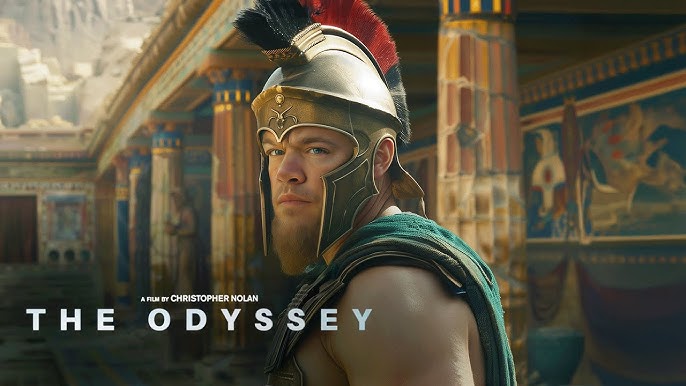
Christopher Nolan's The Odyssey trailer is finally here — and it's everything. Here's a full frame-by-frame breakdown of every hidden detail, casting choice, and what Nolan's approach to Homer actually means for the film.
Introduction: Nolan Just Announced the Most Ambitious Film of the Decade
There are trailers that generate excitement, and then there are trailers that genuinely stop you mid-scroll and make you watch three times before you realize you've been holding your breath.
The first official teaser for Christopher Nolan's The Odyssey is the second kind.
Coming off Oppenheimer — a film about the most consequential event of the 20th century, handled with the kind of moral weight that most directors wouldn't even attempt — the question was always going to be: where does he go next? What could possibly feel like a worthy follow-up to that?
The answer, apparently, is the world's oldest story.
Homer's Odyssey has defeated generations of filmmakers. Its scale, its mythology, its blend of human psychology and divine intervention — adapting it faithfully requires the kind of controlled ambition that almost nobody in Hollywood currently has.
Nolan, uniquely, might.
This breakdown covers every major moment in the trailer, what each detail suggests about Nolan's approach, and why this might be the most important film of the next few years. Let's get into it.
The Opening: Troy as Aftermath, Not Glory
What Nolan Is Immediately Telling You
The trailer's opening shot is a deliberate statement about what kind of film this is going to be.
Troy isn't presented as a mythic battlefield or a gleaming ancient city. It's a cemetery. A slow pan over ruins already half-reclaimed by ash and salt — Greek armor buried in sand, a shoreline that looks less like a coastline and more like the edge of something permanent and desolate.
There's no triumph in this image. No victory parade, no gleaming shields in sunlight. Just the hollow quiet that follows ten years of destruction.
This is Nolan's first declaration: he's not interested in the glory of the Trojan War. He's interested in what it costs the people who survive it.
Odysseus Before the Journey Begins
When we first see Matt Damon as Odysseus — bowing before Agamemnon in the aftermath of the war — the camera doesn't frame him heroically. It frames him as a man who is simply tired.
The posture says everything. The shoulders carry a decade. The eyes have the specific thousand-yard vacancy that belongs to people who have seen too much and processed none of it. He looks like someone who has been telling himself "almost home" for ten years and has started to lose faith in his own promise.
This is a precise and risky choice. The Odyssey's hero is traditionally framed as cunning, resourceful, larger-than-life. Nolan opens on a man who looks like he's already running on empty — before the actual journey even starts. It tells us exactly how the film is going to treat its protagonist: as a human being carrying an impossible weight, not as a mythological figure moving through predetermined glory.
Matt Damon as Odysseus: Why the Skeptics Were Wrong
The Casting Debate, Settled in One Line
When the casting was first announced, the discourse was predictable. Matt Damon as a Homeric king? A Massachusetts-accented Hollywood star in one of antiquity's most iconic roles? The skepticism was loud.
Then the trailer dropped.
The moment Damon speaks — "After years of war, no one could stand between my men and home. Not even me" — the argument ends. It's not the line itself that does it. It's the specific quality he brings to it: the pride and the grief occupying the same breath, the hubris and the self-awareness sharing the same sentence.
Why This Reading of Odysseus Is Interesting
The Odyssey's traditional hero is defined by his cleverness — the man of many turns, the strategist who won the war through deception when brute force failed. That's usually played as confident, even triumphant.
What Damon's delivery suggests is something more psychologically complex: an Odysseus who is fully aware of the cost of his own reputation. Who understands that being "the clever one" meant leading men into decisions that got them killed, and that the cunning which made him indispensable during the war is also the quality that made the gods notice him.
That self-awareness — a hero haunted by his own gifts — is a fascinating angle for a character who has spent centuries being celebrated primarily for those same gifts. It suggests a film interested in the gap between what we're celebrated for and what it actually costs us.
The Practical Effects: Three Shots That Define Nolan's Ambition
Nolan's aversion to computer-generated imagery is one of cinema's better-documented creative commitments. It's also, for a film about wine-dark seas and mythological creatures, his biggest challenge yet. The trailer suggests he's meeting it head-on.
The Trojan Horse
The horse in the trailer is nothing like the gleaming wooden statues Hollywood usually delivers.
It's massive and skeletal and dark — charred planks, scorch marks, visible history written into every beam. It doesn't look like a prop. It looks like the physical remnant of a terrible idea that somehow worked, now standing as a monument to the moral cost of winning through deception rather than courage.
The decision to show it as weathered and haunting rather than impressive is the right one. This horse represents Odysseus's defining victory — and also, arguably, the sin that set the gods against him. Making it look like a nightmare rather than a triumph is thematically exactly right.
The Sea as Antagonist
Working again with cinematographer Hoyte van Hoytema, Nolan has made the Mediterranean look alive in the wrong way.
The ocean in this trailer doesn't read as backdrop. It reads as character — dark, heavy, and operating according to its own logic that has nothing to do with what the humans on its surface want or need. The ships look genuinely small against it, which is technically accurate and emotionally devastating.
The whirlpool shot — practically achieved, based on everything Nolan's production team has discussed publicly — looks like what a whirlpool actually is: not exciting, but terrifying. The kind of natural force that exists entirely outside human scale.
This is Charybdis without naming her. The supernatural made physical. If this is the level of craft being applied to a whirlpool, what happens when the Cyclops arrives?
The Lotus Eaters: Subtlety Over Spectacle
The most quietly impressive sequence in the trailer is easy to miss: a group of men on a sun-drenched beach, surrounded by strange flora, faces slack with a contentment that looks nothing like peace.
There are no digital effects making this look "dreamy." Just overexposed light, slightly-too-still bodies, and an ambient wrongness that creeps in slowly. It's a fever dream rendered in realism — which is exactly the right approach for a sequence about forgetting that you want to go home.
The Lotus Eaters episode in Homer is brief but philosophically loaded: the idea that the greatest threat to the journey isn't violence, but comfort. The temptation to simply stop wanting to return. Nolan's visual approach captures that without announcement, which is the most effective way to do it.
Ithaca: The Story Happening at Home
Why the Home Front Matters as Much as the Journey
One of the tragedies of most Odyssey adaptations is that they treat Ithaca as connective tissue — the thing we're waiting to get back to, rather than a story in its own right.
The trailer suggests Nolan isn't making that mistake.
The contrast between the Mediterranean chaos and the palace at Ithaca is jarring in exactly the right way. The sea is loud and kinetic and dangerous. Ithaca is quiet and suffocating and dangerous in a completely different way — the danger of people who have too much time and too much proximity to power that isn't theirs.
Tom Holland as Telemachus: The Right Kind of Unexpected
Telemachus is one of the most underwritten characters in Odyssey adaptations despite being one of the most interesting in the source text. He's a young man who grew up as a legend's son without ever knowing the man — who has had to hold a household together while being systematically disrespected by men twice his age who want what his father left behind.
That's a rich character, and Holland's casting makes complete sense when you think about it from that angle rather than from surface metrics. He's spent years playing characters defined by their relationship to older, more powerful figures (a specific kind of Marvel experience that turns out to be surprisingly good preparation for Telemachus). The frustration in the brief glimpses we see — a kid treated as a nuisance in his own home — reads as completely authentic.
Anne Hathaway as Penelope: Hope as Resistance
Penelope is arguably the most complex character in Homer's text, and one of the most consistently underserved in adaptation.
She is not simply waiting. She is actively resisting — holding her home against an occupation of entitled men through cleverness, patience, and a kind of hope that she has turned into a deliberate weapon. Her famous weaving-and-unraveling trick is an act of defiance disguised as domesticity.
Hathaway conveys something of this in just a few seconds of trailer. The stillness she projects isn't passivity — it's controlled. There are people counting the days until they can stop pretending to respect her, and she knows it, and she's keeping score.
The Suitors fill the palace like an infestation — loud, invasive, steadily consuming a home that isn't theirs. Setting that against Penelope's measured endurance establishes Ithaca as a siege narrative, which is exactly what it is.
Nolan and Time: The Non-Linear Theory
What the Trailer's Structure Suggests
Nolan has built an entire filmography around time as a storytelling tool — Memento, Dunkirk, Inception, Tenet, Oppenheimer each use temporal structure differently but with the same underlying instinct: that when we experience information shapes how we experience it emotionally.
The Odyssey is ideal material for this approach. Homer's poem is famously non-linear — it opens in the middle of the journey, uses extended flashbacks, and cuts between Ithaca and the sea with a rhythmic precision that feels almost cinematic despite predating cinema by three thousand years.
The trailer already jumps between Troy's aftermath, the sea journey, and Ithaca with a specific rhythm — not chaotic, but patterned. It suggests a structure where we're experiencing multiple timelines simultaneously rather than sequentially.
The Father-Son Mirror Theory
The most intriguing structural possibility: Nolan tells Odysseus's journey and Telemachus's growth in parallel, connected by visual or temporal rhymes that make the decade-long separation feel immediate.
Imagine Odysseus navigating by stars on the Mediterranean, cut directly to Telemachus studying those same stars from the palace roof. The same sky spanning the absence between them — a decade of separation experienced as a single shared moment.
That's not a guess. That's just what Nolan does. He finds the structural metaphor that makes the emotional truth of a story feel inevitable, and he commits to it completely.
The Questions the Trailer Deliberately Leaves Open
Nolan is too good at this to show his hand in a teaser. But the elements we didn't see tell us as much as the ones we did.
How Will He Handle the Supernatural?
The Odyssey is dense with divine intervention — Poseidon actively persecuting the journey, Athena guiding it, Circe transforming men into pigs, the Sirens, the Cyclops, the descent into the Underworld.
These are, in most hands, the elements that turn an Odyssey adaptation into a fantasy film. Nolan doesn't make fantasy films. He makes films where extraordinary things feel real because they're grounded in physical and psychological specificity.
His options are essentially:
- Make the gods forces of nature rather than characters (the storm is Poseidon's anger; the calm is Athena's favor)
- Render mythological creatures through practical effects with such care that they feel genuinely threatening rather than spectacular
- Find a psychological reading of divine intervention that externalizes internal states
The whirlpool shot suggests the first approach is at least part of the answer. Whether that extends to the Cyclops, the Sirens, and Circe remains the film's most interesting open question.
What Does Circe Look Like in Nolan's World?
The enchantress who turns men into pigs and holds Odysseus on her island for a year is a character that collapses under lazy handling and becomes extraordinary under careful attention.
In the poem, she's not simply a villain. She's a test — of Odysseus's loyalty, of his desire, of whether "the clever man" can be outmaneuvered by someone equally intelligent and more prepared. The island episode is about what happens when the most resourceful man in the world meets someone who anticipated his resources.
That's a fascinating character dynamic for Nolan to work with. Who they've cast, and how they've chosen to render her power, will say a great deal about the film's thematic ambitions.
What Makes This Different from Every Previous Odyssey Adaptation
A brief comparison is useful here for understanding what Nolan is attempting:
Most screen adaptations of The Odyssey have treated it primarily as an adventure narrative — the episodic structure lends itself to spectacle, and the monsters and magic provide ready-made set pieces.
What makes Homer's text genuinely profound is something different: it's a story about what "home" means to someone who has been changed so fundamentally that home may no longer fit them. Odysseus arrives back in Ithaca after twenty years — ten at war, ten trying to return — and has to pretend to be a beggar in his own palace. He's unrecognizable. The question isn't just "can he get back?" It's "who is he when he gets there, and is the man who arrives the same one who left?"
That's the film Nolan appears to be making. Not an adventure movie with mythology as the backdrop, but a psychological study of identity, survival, and the terrible difficulty of returning to a life you've been away from long enough that it no longer knows your shape.
Tips for Watching the Trailer Again (And What to Focus On)
If you haven't rewatched yet — and you absolutely should — here's what deserves specific attention:
- Odysseus's hands in the opening sequence: The specific way Damon holds his body tells you more about the character's exhaustion than any dialogue
- The Ithaca color palette: Warmer, more amber, deliberately domestic in contrast to the cold blues of the sea — Nolan and van Hoytema are using color to separate the worlds
- The scale of extras in the Troy sequences: The number of bodies in frame is staggering for a practical shoot and tells you exactly how committed the production is to physical reality over digital augmentation
- Penelope's posture: Hathaway plays stillness as active resistance rather than passive waiting — watch specifically how she holds herself when the Suitors are in frame
- The light quality in the Lotus Eaters scene: Deliberately overexposed, bleaching the edges of the frame in a way that evokes sensory overwhelm without any digital manipulation
FAQ: Everything the Trailer Made Us Wonder
When does Christopher Nolan's The Odyssey release?
The film is currently scheduled for release in 2026, with a planned IMAX rollout. Given Nolan's track record with theatrical presentations, expect this to be positioned as a premium large-format experience.
Is The Odyssey faithful to Homer's original poem?
The trailer suggests Nolan is working from the source text rather than any specific prior adaptation, with an emphasis on psychological realism over mythological spectacle. How faithfully the supernatural elements are handled remains to be seen.
Why was Matt Damon cast as Odysseus?
Damon's casting makes more sense through the lens of Nolan's interpretation than through traditional Homeric hero framing. This is an Odysseus defined by psychological weight and self-awareness rather than physical dominance — a quality Damon has demonstrated across his career in roles that emphasize intelligence under pressure.
Will the gods appear as characters in the film?
Unknown from the trailer, though the approach to the sea and the weather suggests Nolan may be rendering divine intervention as physical phenomena rather than anthropomorphic characters. This would be consistent with his general preference for grounded realism.
What's the significance of the Trojan Horse's appearance in the trailer?
Beyond the obvious narrative function, the Trojan Horse's weathered, burnt appearance signals Nolan's thematic angle: Odysseus's greatest victory was also his greatest moral compromise. The horse looks haunted because it should.
What film size is The Odyssey being shot in?
Nolan is shooting in 70mm IMAX, consistent with his approach on Oppenheimer and Dunkirk. This is one of the primary reasons the theatrical experience will be substantially different from streaming.
Conclusion: This Might Be the Most Important Film of 2026
The Odyssey has always been, at its core, a story about one unbearable question: what does it mean to finally come home after you've been remade by everything you survived to get there?
Nolan is the right director to ask it. He's spent his career exploring the relationship between time, identity, and the stories we tell ourselves to survive — Memento's fragmented memory, Dunkirk's compressed present tense, Oppenheimer's reckoning with consequence. Every one of his films is, in some way, about people who cannot go back to who they were.
The Odyssey is the oldest story about exactly that problem.
The trailer doesn't give us the film. It gives us the promise of a film — the atmosphere, the ambition, the specific quality of attention being paid to a text that has outlasted every civilization that has ever tried to adapt it.
That's enough, for now. That's more than enough.
What hit you hardest? Is it the Trojan Horse? Damon's line reading? The specific way Hathaway holds herself in the palace? Tell me in the comments — because I've watched this four times and I find something new every time.
.png)


No comments:
Post a Comment