
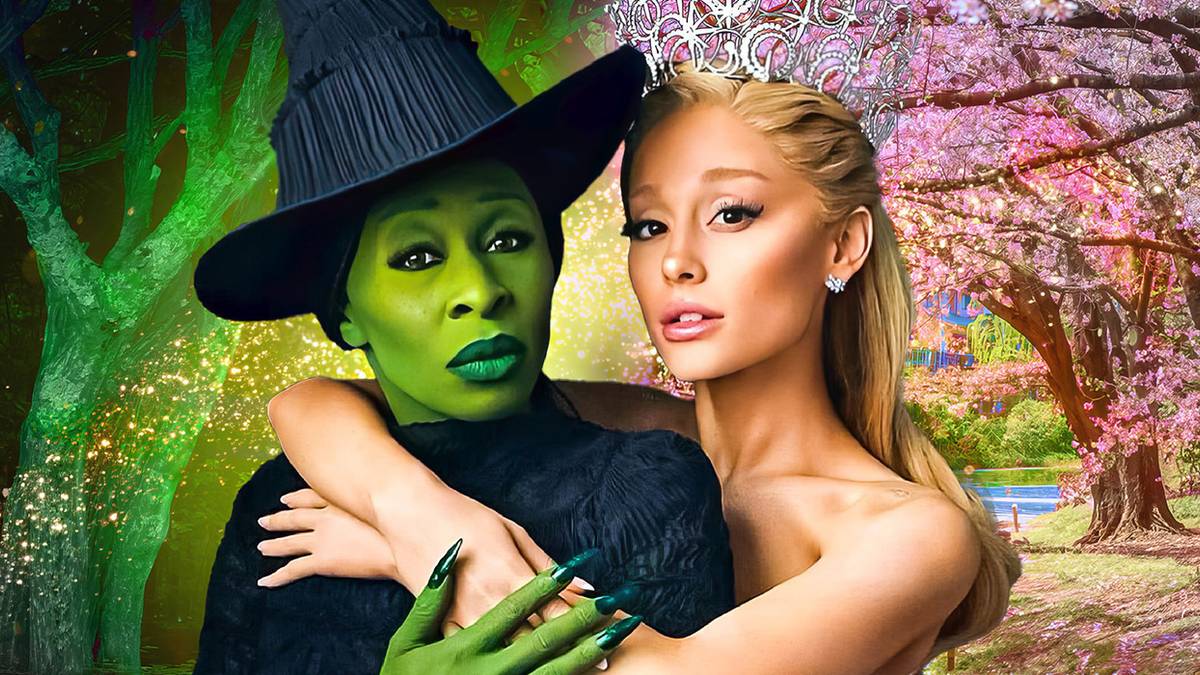
Wicked Part Two is here and it's devastating in the best possible way. Full breakdown of every Easter egg, hidden detail, and emotional moment from Jon M. Chu's stunning conclusion.
Introduction: I'm Not Okay, and I Suspect You Aren't Either
If you're reading this, there's a reasonable chance you just walked out of a theater with ruined mascara and absolutely no idea what to do with yourself for the next several hours.
Same. We're in this together.
The wait between Wicked Part One and Part Two felt genuinely unreasonable — the kind of intermission that tests your patience and your emotional reserves simultaneously. But seeing the second act finally brought to life on that screen, with Jon M. Chu clearly operating at the absolute peak of his craft? It was worth every single agonizing month of waiting.
This isn't just a sequel to Part One. It isn't even just an adaptation of the second act of one of Broadway's most beloved musicals. It's a love letter to every version of this story that has ever mattered to anyone — Gregory Maguire's dark, politically complex novel, the 1939 Judy Garland film, the original stage production that has been making audiences cry for over two decades. Every layer is present, and the film rewards the people who know where to look.
I'm going to take you through every significant detail I noticed — and I was watching very carefully, even through the parts where I temporarily couldn't see properly due to circumstances beyond my control involving the "For Good" sequence.
Personal rating: 8 out of 10. The missing two points exist solely because my heart is in several pieces and someone should answer for that.
Let's begin.
The Opening Logo: A Deliberate Portal to 1939
This is such a specific detail and I love that Chu put it first, before anything else, setting the entire tonal frame of the film in the space of a ten-second studio logo.
The vintage Universal logo — the style from the 1930s, not the current version — appears at the start of the film, and if you recognized it immediately, you felt what it was designed to make you feel: instant, physical transportation back to the 1939 Victor Fleming classic. Back to the Oz you met as a child, or the Oz your parents showed you, or the Oz that has been the cultural shorthand for magical wonder for almost ninety years.
It's a meta-textual welcome home. The film is saying, before a single character appears: you know this place. You have always known this place. And we are about to show you all the parts of it you were never allowed to see before.
If you watched the globe closely — and I had to rewatch this specific moment because I almost missed it — there is a tiny tornado forming inside it. Not weather. Not atmosphere. The film's immediate, wordless reminder that in this version of the story, the storm is destiny. The storm is what brought Dorothy here, what started everything, what will eventually give Elphaba the escape she needs. The tornado is always already present, turning slowly, waiting for its moment.
That is beautiful filmmaking before the movie has technically begun.
Twelve Tides Turned: The Weight of Lost Time
The film gives us a specific timeline early on — twelve tides turned — and then shows us, rather than tells us, exactly what that span of time has done to everyone.
The aging visible on characters like the Cowardly Lion is more than cosmetic. It's the physical evidence of what sustained fear and sustained loss do to a living creature. He hasn't just gotten older. He has been ground down by time spent in a world that has spent those twelve tides actively constructing a mythology around the woman he once knew.
The scale of the anti-Elphaba propaganda is staggering. Posters, stories, the kind of cultural saturation that requires sustained institutional effort to produce and maintain. This is not spontaneous public opinion. This is a campaign. The Wizard's apparatus has been working continuously for those twelve tides to transform a woman who was alive and complicated and specific into a symbol simple enough to frighten children with.
Glinda has become a forced icon on the other side of that same machinery. The smiling face of a regime. Beloved and trapped in equal measure, performing cheerfulness for audiences who don't know — and have been carefully arranged not to know — what it costs her.
Seeing how much both women have lost in the time they spent apart, and how differently that loss has shaped them, gives the reunion everything it needs to land with full weight.
The Skarks: A Detail Just for the Book Readers
This one is specifically for anyone who came to Wicked through Gregory Maguire's novel rather than the stage show, and if you caught it in real time I genuinely respect your attention to detail.
The yak-like creatures being used as beasts of burden by the Wizard's guards — hauling bricks, doing labor, subjugated in the background of a scene that isn't about them but is completely about them — those are almost certainly Skarks from Maguire's source material. They appear in the novel as a species that exists in the margins of the story, barely described, easy to overlook. Which is precisely the point of including them here.
The central horror of Wicked's second act is the systematic silencing and subjugation of Animals — sentient creatures who speak, who think, who have inner lives, and who are being stripped of those inner lives by the Wizard's regime with the same bureaucratic efficiency that real-world atrocities have historically used.
Seeing the Skarks used as work animals in the background of a scene that the foreground characters don't even acknowledge isn't just a lore nod for book fans. It's the film doing exactly what Maguire's novel did — making you watch something terrible happen in the corner of the frame while the main story continues, and trusting you to be disturbed by that.
Elphaba Coming Undone: What Her Appearance Is Actually Saying
The costume and hair choices for Elphaba in Part Two deserve their own extended analysis, because they are doing consistent, specific, layered work throughout the entire film.
She's still wearing the same tunic from Part One. But it's frayed now. Distressed at the edges. The garment has been living the same fugitive life she has, and it shows. There's a particular kind of visual storytelling in clothes that have visibly been worn through hardship — they communicate, without dialogue, exactly what the character has been enduring.
Her hair — the tight micro-braids established in Part One — is unraveling. Loosening. Thickening into something wilder and less constrained. And here is where the visual storytelling becomes genuinely sophisticated: she is literally coming undone under the pressure of everything being done to her and everything she has had to do. The external evidence of internal fracture.
But simultaneously — and this is the part that gets me — she is becoming more herself. The tighter, more controlled presentation of Part One belonged to someone who still believed the system could be worked with, who still had hope that the right appeal to the right authority might change things. This version of Elphaba has burned through that hope and come out the other side into something rawer and more honest and, in certain lights, more free.
Pay attention to the Hair Flip. Both Elphaba and Glinda use it at specific moments throughout the film — always in scenes where they are feeling most vulnerable, most cornered, most stripped of agency. It's a tiny physical reclamation. A moment of I am still here, I still have this, you haven't taken everything. As a visual motif connecting two women who have been separated and shaped by forces larger than either of them, it's elegant and quietly devastating.
The WizMart Pop-Up Book: The Most Efficient Heartbreak in the Film
This detail absolutely wrecked me, and I want to make sure everyone who missed it in real time gets a chance to feel it properly.
In Part One, there is a scene where Elphaba looks at a pop-up book of the Wizard with unguarded, genuine wonder. She's young enough and hopeful enough and still operating under the belief that this man might be someone worth admiring. The image of her face in that moment — open, wanting, not yet defended against disappointment — is one of Part One's most important quiet details.
In Part Two, at the WizMart, there is a pop-up book for sale. A children's product. And inside that pop-up book, in the same visual format she once looked at with wonder, she is the monster. The figure that jumps out to frighten children. The villain of the story, rendered in the same paper-and-color aesthetic as the hero she once admired.
She went from the audience of that storybook to the antagonist inside it. The form is identical. The content is inverted completely.
If Jon M. Chu and his creative team had done nothing else in this film besides engineer that specific callback, it would still be doing more emotional work than most movies manage in their entire runtime.
The Tin Man Sequence: This Is Actually a Horror Movie
I want to be clear about something: the Tin Man transformation sequence is genuinely frightening, and I think that is exactly the correct creative choice.
It isn't magic in the way the musical usually presents magic — sparkles and color and wonder. It is physical horror. Watching Boq transform involves actually watching it happen, seeing the process of a human body being overtaken by metal, and the detail that makes it most disturbing is the specificity.
Look at his wrists. Look at his chest. The silver platter and tea set that melt into his limbs to form the exoskeleton carry the "M" monogram and the decorative patterns from his Munchkin household. The objects of his former life — the life he had before everything went wrong, before love and magic and political catastrophe converged to take everything from him — are now literally fused to his body.
He is going to spend the rest of his existence wearing the evidence of what he lost. Every joint, every surface, every reflective inch of him is a reminder of the person he used to be. That isn't just tragedy. That is the specific, meticulous cruelty that Maguire's Oz traffics in — the way the world doesn't just hurt you but memorializes the hurt in a form you cannot remove or escape.
It's gruesome. It's perfect. It made me look away for a second and then look back because I needed to see all of it.
Glinda's Entrance and the 1812 Overture: Spectacle Hiding Terror
Glinda's entrance is designed to be pure spectacle, and it succeeds completely on that level. The production design, the choreography, the sheer visual commitment of the sequence — it's everything you want from a Glinda entrance, amplified.
But listen to what the guards are chanting beneath the spectacle.
It's the melody of Tchaikovsky's 1812 Overture. A war anthem. A piece of music written to commemorate military victory, historically performed with actual cannon fire, one of classical music's most explicit celebrations of martial power. And it's being synchronized with the melody of "Popular" — the song that, in Part One, represented Glinda at her most superficially charming and least self-aware.
The film is making an argument in musical language: Glinda is the beautiful, smiling face of a military regime. The cheerfulness is the point. The approachability is the mechanism. If the Wizard's power wore a face that looked like power, people would be afraid of it. It wears Glinda's face instead, and people applaud.
Her wand deserves a separate note. It's designed to resemble a bubble in the moment of bursting — not a whole, intact bubble, but one caught at the instant of dissolution. She is constantly framed by circles and mirrors throughout the film, enclosed, reflected back at herself, trapped in a beautiful and perfectly calibrated cage. The wand she uses to perform magic and manage public perception is shaped like the very thing that describes her existence.
I don't know whether to call that brilliant or unbearable. I think it's both.
"For Good": The Film's Emotional Center
I am going to attempt to write about this song without completely losing my composure. I make no guarantees.
The lyrical structure of "For Good" is so intentional that it rewards multiple listens even before you're watching it performed, and watching it performed in this film adds layers that the stage version, as magnificent as it is, simply cannot access in the same way.
Glinda's imagery throughout her verse is gravitational — comets, streams, things that follow a fixed path determined by forces external to themselves. Her life, before Elphaba disrupted it, was a trajectory. She was going where people like her go, becoming what people like her become, and the path was so well-established that she barely had to choose it. Elphaba crashed into that trajectory the way a comet crashes into a gravitational field.
Elphaba's imagery is about being set free — ships navigating by fixed stars, seeds carried by the wind to somewhere they could grow. She has found, in the most painful and costly possible way, something that feels like freedom. Her images point outward and forward. Glinda's point inward and backward.
The harmony is where the real storytelling happens. Glinda takes the lower note. She — who has always sought the spotlight, who performed her way through Part One on the sheer force of wanting to be seen and celebrated — chooses, in this moment, to hold the foundation while Elphaba soars. She grounds the song. She supports her friend.
That is a complete character arc expressed in a single musical choice. The woman who wanted the spotlight has learned, at enormous personal cost, what it means to hold someone else up instead of climbing.
I was not prepared. I should have been prepared. I was not prepared.
The Final Image: A Secret That Belongs Only to Them
The film closes with a recreation of the iconic Broadway poster — Glinda leaning close to Elphaba, whispering something in her ear.
We don't hear it. We are never going to hear it. The film makes a deliberate, confident choice to keep that moment private — not a cliffhanger, not a mystery designed to launch theories, but a genuine act of narrative restraint. Some things between people are not for audiences. Some conversations between friends who have been through everything together belong only to them.
There is something deeply right about ending this story with a secret. A friendship this specific, this tested, this irreducible — it should have something that we cannot access. It should have a room that we are not invited into. The whole movie has been peeling back layers, showing us the parts of this story that have always been there but never fully visible. And then it stops. It lets these two women have one moment that is entirely and permanently theirs.
I love it. It made me cry in a completely different way than everything that came before it — not from grief or recognition or loss, but from the feeling of watching something sacred be treated with appropriate care.
What to Watch For on Rewatch
A few details worth specifically tracking if you're heading back for a second viewing:
- Watch every instance of the Hair Flip and note precisely which emotional state triggers it for each woman
- Track the color red and when it appears in Glinda's costuming versus when it's absent — it maps onto something specific
- Listen for the musical callbacks buried in the background score, particularly pieces from Act One appearing in distorted or minor-key forms
- Watch the Animals in background scenes and note how their presence or absence tracks the progression of the Wizard's regime
- Pay attention to every mirror and reflective surface in Glinda's scenes and what they're positioned to show or conceal
Common Questions About Wicked Part Two
Is Wicked Part Two faithful to the stage musical? It honors the stage show deeply while expanding significantly into the territory of Maguire's novel and the 1939 film. It goes darker and more specific than the stage version can, while keeping the essential emotional architecture intact.
Do you need to see Part One first? Absolutely yes. Part Two begins exactly where Part One ended and assumes complete familiarity with those events and characters.
What is the "twelve tides" timeline? The film establishes that roughly a year has passed since the events of Part One — long enough for the propaganda machinery to fully mythologize Elphaba as a monster and for Glinda to be entrenched as the Wizard's public face.
What are Skarks and why do they matter? They are creatures from Gregory Maguire's original novel, used here as beasts of burden by the Wizard's regime. Their appearance is a specific acknowledgment of the novel's lore and a visual representation of the Animal subjugation that is central to the story's political themes.
What does Glinda whisper at the end? The film deliberately leaves this unanswered. It is a choice, not an oversight, and one that I think is exactly right.
Is the Tin Man transformation sequence suitable for younger children? It is significantly more visceral and frightening than the stage version. Parents should be aware that it reads as genuine body horror rather than musical-theatre magic.
Conclusion: A Love Letter That Earns Every Tear
Jon M. Chu didn't just make a successful adaptation of Wicked's second act. He made a film that understands why this story matters to the people it matters to — and then went further than any previous version into the darkness and the love that make Oz worth caring about.
The vintage Universal logo was a promise: we know where you came from, we know what this place means to you, and we are going to honor that while showing you the parts of it you were never allowed to see before.
The film kept that promise. In every frayed hem and unraveling braid, every carefully placed pop-up book, every bubble-shaped wand and war-anthem chant, every lower note chosen in a final harmony — it kept it.
And then it gave two women a secret, and had the grace to let them keep it.
That's what a love letter looks like. Go cry about it. You've earned it.
.png)


No comments:
Post a Comment