
The Pitt Season 2 Episode 4 delivers one of the most intense hours of the series — a hidden heart attack, a TikTok doctor reveal, Ogilvie's dangerous negligence, and a nightmare bacteria cliffhanger that changes everything. Full breakdown inside.
Hour four of the July 4th shift just looked everyone in the eye and decided to stop being polite about it.
If you are still sitting with your heart rate elevated after that final shot — Debbie's leg, the spreading redness, the infection blowing past the sharpie line like it was never there — you are in good company. The Pitt Season 2 has been building pressure since the premiere, and Episode 4 is where that pressure becomes genuinely difficult to breathe through.
Set between 10:00 and 11:00 in the morning, this episode covers forty-five minutes of screen time that somehow contains a superglue eye injury, a TikTok revelation, one of the most satisfying diagnostic moments of the series, a medical student who is becoming a genuine danger to patients, a deeply moving mental health storyline, and a cliffhanger that suggests the next episode might involve the entire ER becoming a biohazard zone.
Director John Cameron — who brought a similarly oppressive sense of environmental dread to Fargo and Legion — renders the heatwave as a physical presence. The episode feels hot in a way that good cinematography makes possible: every shot is slightly too close, slightly too crowded, the humidity somehow visible in the way light moves through the frames. Watching it, I genuinely adjusted my own air conditioning.
Cynthia Adarca's script does the thing that the best Pitt episodes do — moves between tones without losing the thread. Dark humor, genuine tenderness, procedural tension, character revelation, and creeping existential dread, all in the same hour. It is harder to write than it looks.
Let's go through all of it.

What "Code Black" Actually Means — And Why It Changes Everything
The episode opens with the staff running a betting pool on why the neighboring ER has gone Code Black, and before getting to the character dynamics at play in that scene, it is worth clarifying what Code Black actually means — because the show uses the term specifically, and the specificity matters.
In popular culture, Code Black often signals a bomb threat or armed intruder. In the world of The Pitt, it means something considerably scarier because it is systemic rather than acute. A Code Black signifies critical infrastructural failure — the hospital has run out of the capacity to function. No available beds. Insufficient staff. A complete collapse of the operational framework that allows emergency medicine to happen.
The reason this matters for our ER is immediate and practical: every ambulance that would have gone to the neighboring hospital now comes to Westbridge. The "chilaquiles woman." The parkour guy. Every incoming case that was not originally their problem is now their problem, layered on top of everything they were already managing.
It is the healthcare system's version of a domino effect — one institution's failure becoming another institution's emergency with essentially no warning and no additional resources to handle the overflow.
That context reframes the entire episode. The staff is not just busy. They are absorbing the failure of adjacent infrastructure in real time, which is a fundamentally different kind of pressure.

The Betting Pool — Where Everyone's Head Is At
The betting pool itself is a beautifully efficient piece of character writing. In thirty seconds of dialogue, the show tells you exactly how each person processes stress and what they are paying attention to.
Robbie bets on flooding. This is the move of someone who has worked in aging institutional infrastructure long enough to respect the specific ways it fails. Pipes burst. Ceilings leak. HVAC systems that have been limping along for decades finally stop limping during the exact worst possible weather event. His estimated three-hour downtime is calibrated expectation management — the bet of a man who has stopped being surprised by institutional failure and started building it into his mental models.
Jesse's fireworks-in-a-toilet guess is July 4th dark comedy — a low opinion of the public's relationship with holiday safety expressed through a betting choice. He is not wrong about the general principle. Emergency departments across the country know what holiday weekends look like.
Whitaker goes with power outage, and this is arguably the most tactically intelligent read in the room. A sustained heatwave puts enormous stress on the electrical grid — air conditioning units running at maximum capacity across an entire city, sustained over days, creates demand spikes that aging infrastructure cannot always absorb. Whitaker is thinking about the macro environment, connecting meteorological conditions to systemic vulnerability. This becomes relevant later.
And then there is Dr. Al, betting $21 specifically to beat Robbie's $20 by a single dollar.

Dr. Al's Evolution — The Olive Branch We Did Not Know We Needed
Pause on this moment, because it is doing more character work than it might initially appear.
Early Season 1 Dr. Al was rigid, rule-driven, occasionally terrifying, and emotionally opaque in the way that institutional authority often trains people to become. She was effective, she was respected, and she was fundamentally separate from the team in a way that had nothing to do with her competence.
The woman offering to buy Robbie a drink with her winnings, deploying a Price Is Right strategy to one-up him by exactly one dollar, is someone actively trying to belong to something rather than simply supervising it. That is a significant shift. It is the specific move of a person who has decided that being part of the tribe matters to them — not just leading it, but actually being in it.
It is a small gesture. It is also an enormous one.

Javadi's Secret — The TikTok Doctor Reveal
The Willow-supergluing-her-eye-shut storyline exists primarily to deliver one of the episode's best character reveals, and it earns it.
When Willow asks specifically for "Dr. J," and Langdon's face cycles through confusion before landing on the realization that his resident has an active social media presence large enough for patients to request her by name — that is a generationally specific comedy beat that the show lands cleanly.
Javadi has been building a following giving advice on managing difficult coworkers. She is, in the most technically accurate sense, sub-tweeting her own attending physicians to an audience of thousands. The HIPAA implications of this situation are a ticking clock that the episode wisely leaves running in the background — the violation is not happening yet, but the conditions for it to happen are clearly present.
What makes this interesting beyond the comedy is what it says about Javadi as a character. She came into the series as "Crash" — Santos' dismissive nickname that implied incompetence and chaos. What we are learning is that she has been managing this environment with more sophistication than her fumbling early performance suggested. She found a community, she found an audience, she found a way to process the specific stresses of her training publicly without violating anything yet. That is not incompetence. That is adaptation.

Ogilvie — A Specific Kind of Dangerous
There is a particular type of dangerous person in medicine, and Ogilvie is becoming the show's anatomy lesson in exactly that type.
He is not incompetent in the way that produces random errors. He is incompetent in the way that produces covered-up errors — the kind that get worse before they get caught because the priority is protecting the appearance of competence rather than delivering actual care.
Three moments in this episode define him:
The fist bump. He tries to insert himself into the mentorship moment between Robbie and Whitaker — wanting the warmth of belonging without having built anything that earns it. Being shut down physically, the fist left hanging in the air, is played as cringe comedy. But it is also diagnostic. He wants to be liked more than he wants to understand why he is not liked, which means he will never address the actual problem.
The missed glass shard. Missing a foreign body in a wound during a patient assessment is a serious error. It happens. Medicine is practiced by human beings under imperfect conditions. What is not acceptable is identifying that you have made an error and choosing to conceal it from an attending rather than immediately escalating. He caused significant bleeding by attempting to quietly fix his mistake. He treated a patient as a problem to manage rather than a person to treat, and he did it because protecting his ego was the higher priority in that moment.
The smirk. When Joy cut herself on the glass, Ogilvie's response was a small, visible satisfaction. Garcia's immediate intervention — "Leave the decisions to the adults" — was the correct response, and I suspect most viewers had the same physical reaction of relief when those words landed.
The contrast the episode is drawing between Ogilvie and Santos from Season 1 is deliberate and worth sitting with. Santos was reckless and sometimes dangerous, but the desire beneath the recklessness was genuine — he wanted to be good at this, and that desire was eventually trainable. Ogilvie does not appear to want to be good. He wants to appear good. That distinction, in an emergency department, is the difference between someone who can be taught and someone who will eventually cause a serious harm and find a way not to take responsibility for it.

Whitaker's Coronation — The Posterior STEMI
This is the episode's most satisfying procedural sequence, and it is earned rather than granted.
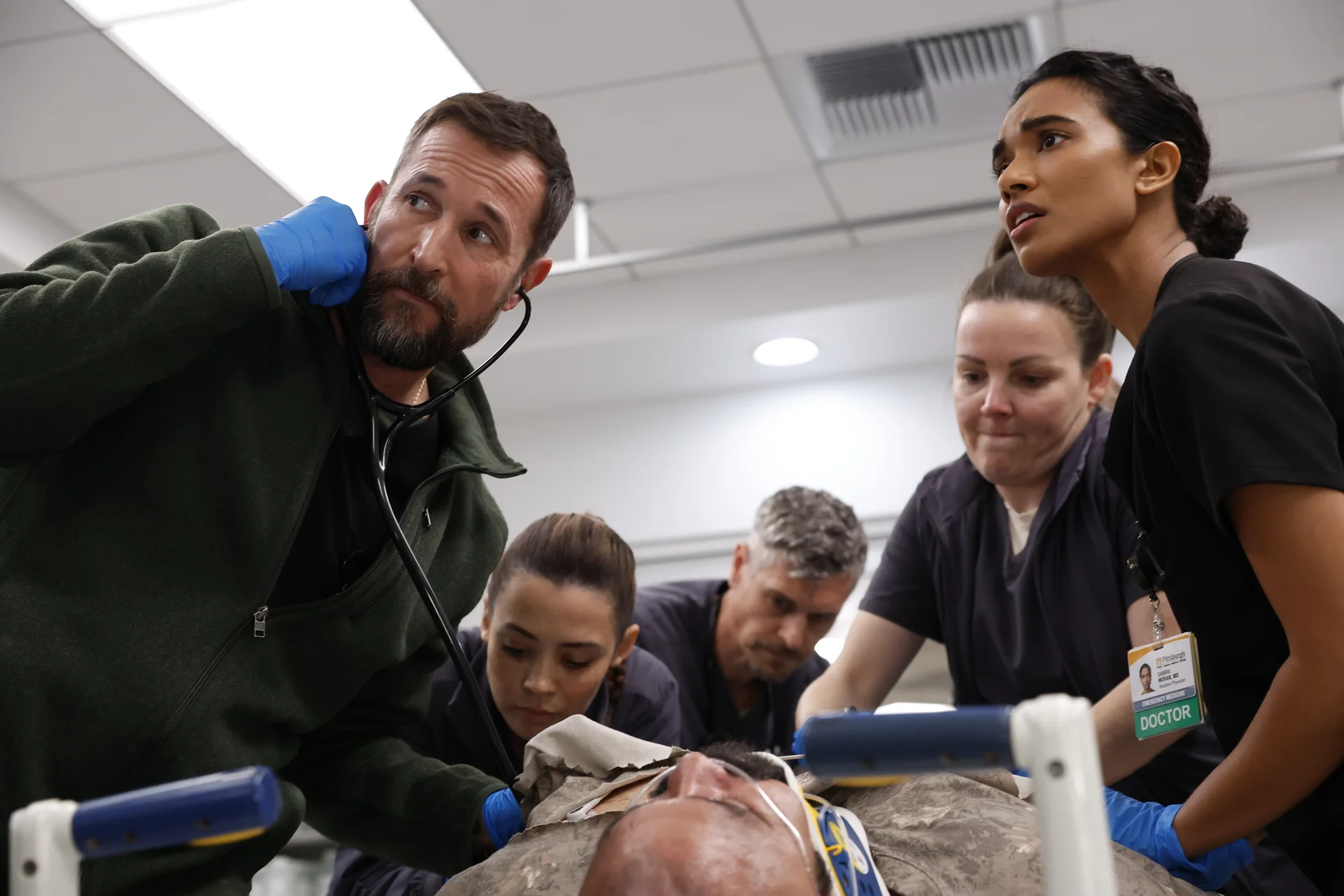
John Samba presents with chest pain. The standard 12-lead ECG looks unremarkable. In an ER running on fumes during a heatwave Code Black overflow situation, the path of least resistance is to clear this patient and move on. The institutional pressure is enormous, Jesse's frustration about bed availability is entirely understandable, and the easy read of the ECG justifies the discharge.
Whitaker pushes for posterior leads. He trusts the clinical picture over the initial test result, and he does it without the confidence of an established diagnostician — he is still a brand-new attending, still finding his authority — which makes the persistence more impressive, not less.
For readers unfamiliar with the specific cardiac anatomy: a posterior STEMI affects the back wall of the heart muscle. The standard 12-lead ECG captures electrical signals from the front and sides of the heart. When the damage is posterior, those signals are often obscured, producing an ECG that looks misleadingly clean. It is a well-documented diagnostic trap. Catching it requires either requesting the additional posterior leads or having enough clinical suspicion to keep looking when the standard workup does not match the presentation.
Whitaker has the clinical suspicion. He presses for the test. He is right — and the patient goes into cardiac arrest within minutes of the confirmed diagnosis, meaning the outcome without Whitaker's persistence would almost certainly have been a patient coding in the waiting room or the parking lot.
Robbie's "Good pickup" is quiet and specific and means everything. That is not a supervisor complimenting a subordinate. That is a senior clinician acknowledging that a junior one just did something genuinely difficult under pressure, and did it well. Whitaker has crossed a threshold in this episode that the season has been building toward.

The Emotional Storylines — Where the Show Earns Its Depth
The Pitt has always understood that the medical cases are not the show. They are the vehicle. The show is about what it costs to do this work, and who these people become as a result of doing it.
Mel's ARFID Disclosure
The Alicia storyline — a patient with bulimia presenting with aspiration pneumonia and doing what eating disorder patients often do, which is minimize and conceal — gives Mel a moment of genuine disclosure that the episode handles with unusual care.
Mel's revelation about her own history with ARFID, and specifically about the sensory component — the way certain textures and foods are not merely unpleasant but genuinely overwhelming to her nervous system — is not treated as a dramatic confession or a character flaw being revealed. It is simply part of who she is, shared in a moment of clinical connection with a patient who needed to feel less alone in her experience.
That is not the standard television approach to neurodivergence. The standard approach makes it a storyline, gives it a narrative arc, resolves it toward some form of acceptance or crisis. What this episode does instead is use it as a window into Mel's clinical instincts — she sees Alicia clearly partly because she recognizes something — and then moves on. The character contains this information. It does not define the character.
Jackson Davis — The High-Achieving Burnout
The resolution of the Jackson Davis case — the young man who was tased after what everyone assumed was drug-induced psychosis — arrives with the toxicology screen. Clean. No drugs.
He was a law student, shouting legal codes during what appears to be a first psychotic break triggered by academic pressure and whatever internal accumulation of stress that finally reached a breaking point with no substances involved at all.
Dr. Jefferson's hesitation around the schizophrenia diagnosis is the most honest moment in the episode's most serious storyline. A psychiatric diagnosis on a medical chart is not a temporary notation. It follows a person through insurance systems, employment screening, future medical encounters, and public perception for the rest of their life. The weight of that labeling is real, and Jefferson's visible reluctance to place it prematurely reflects a clinician who understands what diagnoses cost, not just what they provide.

Relationship Status — The Complicated Edition
McKay's Date
She has a date. With Brian, the foot guy. At 9:00 p.m. She believes she is making this date. She is in the middle of a Code Black overflow shift during a heatwave on July 4th and she believes the universe is going to let her have this one.
The pit in your stomach watching her talk about it is the show working correctly. We know what holiday ER shifts do to personal plans. We know what this show does to moments of anticipated happiness. The date is already a ghost of itself.
Whitaker and Amy
The update on Teddy's widow and the farm visits sits in genuinely ambiguous territory that the show is smart not to resolve. Is Whitaker there because grief and obligation and the particular character of someone who cannot stop caring about people he has touched? Yes, clearly. Is there anything else developing in that space, slowly and ethically complicated? The episode leaves this unanswered in exactly the right way.
Robbie and Langdon
This is the most painful dynamic in the episode because the silence is doing all the work. Langdon is sober. He is trying. He is showing up and doing the job and not asking for anything. Robbie will not look at him.
The refusal to let Langdon leave triage is not punitive management. It is a man who was abandoned by someone he trusted keeping that person at a distance until he has processed whether he can trust again. That process does not have a timeline, and it does not respond to apologies. You cannot logic your way through a wound that deep.
The Ending — What "Or Worse" Actually Means
Debbie has been waiting since Episode 1. Minor foot injury. Sent home or waiting or somehow still in the system while the department managed everything else around her.
She is back. The infection has spread beyond the boundary they drew to track it. The tissue is dark and angry and necrotic-looking. Donnie raises MRSA — methicillin-resistant Staphylococcus aureus — as the working hypothesis, which would be serious enough on its own.
Langdon says "Or worse," and the episode ends.
The "worse" the episode appears to be gesturing toward is CRE — Carbapenem-resistant Enterobacteriaceae, sometimes called "nightmare bacteria" in clinical shorthand. CRE is resistant to nearly all available antibiotics, including the carbapenem class that functions as a last-resort option for other resistant organisms. Mortality rates for bloodstream CRE infections run as high as fifty percent.
If this is what Debbie has, the implications for the episode to come are significant. A CRE case in an emergency department requires immediate infection control response — isolation protocols, contact tracing among staff who have had exposure, potential ward closure. In an ER already operating at overflow capacity during a holiday Code Black situation, a superbug diagnosis does not just threaten Debbie. It threatens the structural ability of the department to function at all.
The season has been building toward something that breaks the container. This might be it.
What to Watch For in Episode 5
A few threads worth tracking as the season develops:
- Ogilvie's next error. It is not a question of whether he makes another one. It is a question of what the consequences are and whether he can continue to evade accountability. Garcia is watching him. That matters.
- The Code Black resolution. Whitaker's power outage theory is the most structurally credible guess in the betting pool. If he is right, the episode has been foreshadowing it through his pattern of noticing the macro environment.
- Javadi's TikTok situation. Hospital administration finding out about a resident with a large following giving coworker advice is a storyline with an obvious escalation point. Watch for it.
- Langdon's re-integration. Robbie is not going to let him back in easily or quickly. But the department cannot function indefinitely with that level of interpersonal fracture in the leadership structure.
- Debbie's diagnosis. If it is CRE, the next episode is a different kind of show entirely.
FAQ: The Pitt Season 2 Episode 4
What is a Code Black in The Pitt universe? In this show's medical setting, Code Black means critical infrastructural failure — the hospital has run out of the resources necessary to function. No available beds, insufficient staff, systemic collapse. It is not a security threat; it is a logistical one, and it is arguably more frightening for being systemic rather than acute.
What is a Posterior STEMI and why is it hard to diagnose? A Posterior STEMI is a heart attack affecting the back wall of the heart. Standard 12-lead ECGs often miss it because the electrical signals are obscured by the heart muscle itself, producing a misleadingly normal-looking result. Catching it requires additional posterior lead testing and the clinical suspicion to push for it when the standard workup does not match the presentation.
What is ARFID and how did the episode handle it? ARFID stands for Avoidant Restrictive Food Intake Disorder — a condition involving significant limitation of food intake based on sensory sensitivity, fear responses, or other factors unrelated to body image concerns. The episode used Mel's personal disclosure about her own ARFID to create a moment of connection with a patient with bulimia, handling the neurodivergence as a characteristic rather than a dramatic revelation requiring resolution.
What is CRE and why is it called "nightmare bacteria"? CRE stands for Carbapenem-resistant Enterobacteriaceae — a category of bacteria resistant to nearly all available antibiotics, including the carbapenem class that serves as a last-resort treatment option. Bloodstream infections carry mortality rates as high as fifty percent. An outbreak in a hospital environment requires immediate, extensive infection control response and can force ward closures.
Why won't Robbie forgive Langdon? The show has not fully detailed the nature of Langdon's abandonment, but the emotional architecture is clear — Robbie trusted someone in a position of significant personal or professional reliance, and that person disappeared during a period when Langdon was struggling with sobriety. Being left by someone you trusted while they were managing their own crisis does not stop hurting simply because they return and are trying to do better.
Is Ogilvie going to cause a serious patient harm this season? The show is building toward this with enough intentionality that it feels like a structural certainty rather than speculation. The question is whether the harm is caught in time, and what the consequences are for a character who has been consistently prioritizing his own image over his patients' welfare.
Final Thoughts
The Pitt is doing something that procedural drama only rarely manages to sustain past an initial season — it is getting more specific, not less, as it develops. The characters are becoming more themselves rather than more archetypal. The medical cases are getting more technically precise without sacrificing emotional clarity. The interpersonal dynamics are accumulating history in ways that make every scene carry weight from previous scenes.
Episode 4 is the best hour of Season 2 so far, and it earns that position not through any single spectacular moment but through the sustained quality of everything happening simultaneously. The Whitaker diagnosis, Mel's disclosure, the Ogilvie situation, Al's olive branch, and that final shot of Debbie's spreading infection — all of it is working together, building toward something that feels genuinely consequential.
The nightmare bacteria cliffhanger is the show announcing that the stakes are about to change scale. Whatever the next episode brings, the department is not going to look the same afterward.
.png)


No comments:
Post a Comment