
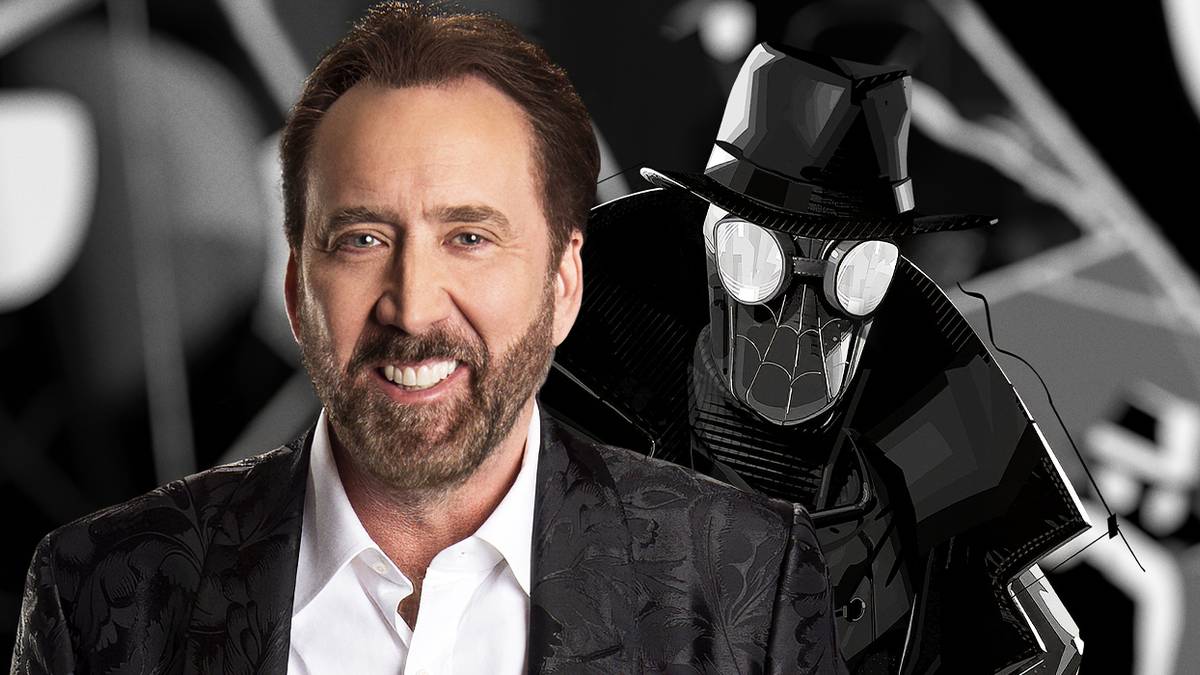
Amazon's Spider-Noir series is finally here in trailers and teasers — and it looks like nothing else in superhero TV. From Nicolas Cage's 70/30 Bogart-Bugs Bunny approach to Sandman in black and white, here's the complete breakdown.
This Is the Superhero Show Nobody Knew They Needed
There's a specific kind of exhaustion that comes with following superhero content in 2026. The multiverse crossovers. The universe-ending stakes that somehow feel lower each time. The mid-credits scenes that demand you've watched seventeen other things to understand what you just saw.
Spider-Noir looks like the antidote to all of that.
Amazon Prime's first proper trailer for the live-action series landed with the kind of confident, atmospheric thud that makes you sit up and actually pay attention. Rain-slicked streets. Jazz-era New York draped in shadow. And Nicolas Cage — finally, actually, in live action — playing a Spider-Man who sounds like he hasn't slept in a decade and has strong opinions about the futility of hope.
This isn't a universe-builder. It's not laying groundwork for five future projects. It appears, based on everything revealed so far, to be exactly what it says on the tin: a gritty, 1930s-set noir detective story about a broken man in a broken city, wrapped in the visual language of classic cinema and anchored by one of the most genuinely unpredictable actors working today.
Let's break down everything the show has revealed and why it's generating the kind of genuine enthusiasm that's become increasingly rare in this genre.

Black and White or Color? This Creative Decision Is Bolder Than It Sounds
The first thing to understand about Spider-Noir is that you're going to have a choice before the first episode even starts.
Amazon is releasing the series in two versions: a standard color cut and a stylized black-and-white mode. Before you dismiss this as a marketing gimmick designed to generate think-pieces, consider what it actually signals about the show's creative ambitions.
The black-and-white version isn't a filter applied after the fact. It appears to be the intended "pure" experience — the version where the visual language of classic noir is fully realized. In that format, shadow does half the storytelling work. The contrast between light and dark isn't decorative; it's thematic. Cinematographers working in the noir tradition understood something that gets lost in modern, brightly lit productions: moral ambiguity lives in shadow. Characters who exist in grey areas literally live in grey light.
How Color Becomes a Narrative Tool
The creative team has teased that even within the monochrome version, specific moments may break into color — a technique that transforms color from visual default into emotional punctuation.
If you've seen Into the Spider-Verse, you already know exactly how devastating this device can be. The Rubik's Cube sequence in that film hits harder than anything that surrounds it precisely because the color makes it feel like something breaking through. The same principle, applied in reverse — starting from black and white and introducing color as exception — gives those moments an almost shocking weight.
This puts Spider-Noir in company with films like Schindler's List and Sin City, both of which used selective color as a storytelling device rather than pure aesthetics. It's a sophisticated choice, and the fact that the show commits to it this fully suggests a production that understands exactly what kind of story it's telling.
The color version exists for viewers who want to appreciate the costume textures, the production design details, the full richness of 1930s set dressing. Neither is wrong. But the choice itself tells you something important: this is a show made by people who thought carefully about how you experience it, not just what you experience.

Ben Reilly: Why This Character Choice Is Smarter Than It First Appears
One of the most interesting decisions the show made early in development — and one that pays off significantly in terms of tone — is the choice of protagonist.
Nicolas Cage is not playing Peter Parker.
He's playing Ben Reilly, a down-on-his-luck private investigator barely holding his life together in Depression-era New York. For comic readers, that name carries decades of complicated history. Ben Reilly is the character at the center of the 90s Clone Saga — one of Marvel's most controversial storylines, in which it was revealed that Peter Parker had been cloned by the Jackal. The name itself is a composite tribute: "Ben" for Uncle Ben, "Reilly" from Aunt May's maiden name. A name literally constructed from grief and family.
In the comics, Reilly occasionally took over the Spider-Man mantle when Peter stepped back. More recently, he appeared in Across the Spider-Verse as the self-narrating, aggressively angsty 90s-era Spider-Man — a character who functions as a loving parody of the era's excesses.
Why "Ben Reilly" Works Better Here Than Peter Parker Would
Showrunner Oren Uziel has been direct about the reasoning: "Peter Parker" is culturally synonymous with a very specific kind of youthful energy. High school. Wide-eyed idealism. The friendly neighborhood version of heroism that's been established across decades of film and television.
That's the wrong energy for this story.
Ben Reilly, as a name and as a concept, carries none of that baggage. He's been through things. He carries the weight of someone who started with belief in something and had it gradually worn away. In this series, Reilly was once simply known as "The Spider" — New York's only costumed hero, operating in a city that was slowly forgetting him along with everything else it couldn't afford to maintain.
Note that the title is Spider-Noir, not Spider-Man Noir. Part of this is likely licensing complications between studios. But the effect of removing "Man" from the title is tonal as much as legal. "The Spider" sounds like something out of a pulp serial — closer to The Shadow or The Spirit than to the cheerful hero of the Saturday morning cartoons. It's a name that belongs to someone who moves through alleys, not skyscrapers. Who is feared rather than celebrated.
That distinction is the entire show, compressed into a title.

Nicolas Cage's Performance: 70% Bogart, 30% Bugs Bunny
At some point in this production, Nicolas Cage told Esquire that his approach to the character is "70% Humphrey Bogart and 30% Bugs Bunny."
This quote should be framed and hung in acting schools.
It captures something essential about what makes Cage uniquely suited to this role — and uniquely capable of making it work where a more conventionally serious actor might produce something suffocating and airless.
What the Bogart Brings
The 70% Bogart is the foundation. It's the world-weariness that lives behind Cage's eyes in the trailer footage. The gravelly internal monologue that rumbles through the voiceover. The way he holds himself like a man who's learned to expect disappointment and has made a kind of peace with it.
Sam Spade. Philip Marlowe. Characters who maintain a rigid personal code not because they believe the world will reward them for it, but because the code is the only thing keeping them from becoming what they fight. Cage appears to understand this archetype completely — and more importantly, he appears to understand that playing it completely straight would be a mistake.
What the Bugs Bunny Adds
The 30% Bugs Bunny is what separates this from every other brooding superhero performance of the last decade.
It's the manic edge. The willingness to be slightly unhinged in a way that makes you uncertain whether to laugh or feel concerned. The line from the trailer — "With no power comes no responsibility" — is delivered with a particular chaotic energy that only Cage can manufacture. It's a perfect inversion of the classic Spider-Man motto, and the way he says it tells you exactly where this character lives mentally: he's not just cynical, he's actively constructing a philosophy out of his cynicism to protect himself from the alternative.
The combination prevents the show from collapsing under its own atmosphere. Noir can become oppressive when everyone commits to the grimness without relief. The Bugs Bunny 30% is the pressure valve. It's also, incidentally, the most Cage thing imaginable — and that's not a criticism.

The Villains: Perfectly Cast for a Jazz-Age Crime Story
A noir needs its criminals, and Spider-Noir has assembled a rogues' gallery that makes a lot of sense for the period and the tone.
Sandman — Elemental Horror in Monochrome
Flint Marko, the Sandman, is played by Jack Huston — and the production's commitment to realizing this character properly reportedly required a significant budget fight between producers Phil Lord and Chris Miller and the studio.
The studio eventually agreed to go all in on the visual effects, and in a noir context, the creative potential is remarkable. Sandman rendered in high-contrast black and white becomes something genuinely unsettling — shifting particle effects creating monstrous, swirling shapes in the shadows, sand constructs that look less like comic book villainy and more like elemental horror. He stops being a superpowered criminal and becomes something closer to a force of nature in human shape.
Expect major set pieces built around this visual vocabulary. The contrast between the gritty physical reality of Depression-era New York and the supernatural fluidity of a man who dissolves into sand is exactly the kind of juxtaposition this show seems designed to exploit.
Silvermane — The Crime Boss Who Fears Death
Brendan Gleeson is rumored to be playing Silvio Manfredi, better known as Silvermane — a Maggia crime boss (Marvel's equivalent of the Italian-American Mafia) defined by his ruthlessness and his obsession with cheating mortality.
The casting is almost too good. Gleeson has spent a career embodying men who command rooms without raising their voices — characters whose authority is so completely settled that violence feels like an afterthought rather than a first resort. As an aging mob boss who has clawed his way to the top of New York's criminal hierarchy and isn't ready to let age take it from him, he's a perfect fit for the period.
The storyline the show could adapt — the "Tablet of Time" arc, in which Silvermane pursues a mystical artifact capable of restoring his youth — fits the 1930s pulp mystery tradition beautifully. An elderly gangster hunting an ancient artifact to escape death is exactly the kind of plot you'd find in a serial adventure story from that era. It anchors the supernatural elements in something recognizably human: greed, fear of mortality, the desperate refusal to accept that time wins eventually.

The Supporting Cast: Classic Archetypes, Thoughtfully Updated
The world around Reilly is being populated with characters that feel true to noir conventions while carrying enough specificity to avoid feeling like genre furniture.
Robbie Robertson (played by Lamorne Morris) brings the Daily Bugle's most principled reporter into a 1930s context where investigative journalism meant genuinely risking your life to expose powerful men who didn't want to be exposed. In most adaptations, Robbie functions as Peter Parker's moral anchor — the person who suspects more than he says and chooses respect over revelation. Here, in a world where the press is one of the few institutions capable of holding criminal empires accountable, his role carries different weight.
Kat Hoddy (Li Jun Li) is described as a mysterious singer and starlet — which is the noir genre's way of saying "femme fatale," and the show appears to embrace that archetype fully. In the tradition of classic noir, the femme fatale isn't simply a romantic interest or an antagonist. She's a figure of genuine moral complexity — someone operating with her own agenda, her own survival instincts, and her own code that may or may not align with the protagonist's at any given moment. The comparisons to Black Cat are obvious and probably intentional.
Lemuel (Abraham Popoola), a World War I veteran, adds something the other characters can't provide: lived historical weight. The 1930s are shaped by the trauma of a war that ended less than twenty years earlier, and a character who carries that experience into every scene grounds the show in something real. These aren't people living in a stylized past — they're people navigating the consequences of history.

Visual Language: Every Frame Is Doing Work
The trailer footage rewards close attention in a way that suggests a production with genuine cinematic ambitions.
The showrunners have cited Batman: The Animated Series and Art Deco architecture as primary visual influences — which explains the sense of a New York that feels both historically grounded and slightly heightened. Towering spires. Gargoyles. A verticality that makes individuals feel small against the machinery of the city. It's Gotham's DNA applied to a real historical moment.
Construction Sites and Inequality
A recurring visual motif in the footage involves Reilly navigating the city's construction sites — massive skeletal structures rising above streets where people are struggling to eat. This is not accidental.
The imagery evokes the famous "Lunch atop a Skyscraper" photograph from 1932 — workers eating casually on a beam dozens of floors above the city — and uses it thematically. New York was physically building itself upward during the Depression, constructing monuments to ambition while the people on the ground couldn't sustain themselves. The juxtaposition of Reilly, a man falling from grace, moving through spaces designed to represent human ascension is the kind of visual metaphor that makes a production feel considered rather than assembled.
The Therapy Scene and the Spider in Glass
One particular sequence stands out for what it's doing beneath the surface. Reilly sits in what appears to be a therapy session, and across from him — entombed in glass — is a massive spider.
Mirrors and reflective surfaces are fundamental noir devices. They represent duality, the gap between the self someone presents and the self they can't escape. The spider behind glass is Reilly's shadow — the creature he became, the identity he can't fully inhabit or fully abandon. It's contained but present. Always watching from the other side of something transparent.
The visual storytelling here is dense enough that a single frame tells you most of what you need to know about where this character is emotionally.
Common Misconceptions About What This Show Is
A few things worth clarifying before the series premieres, given some of the discourse already circulating:
- This is not a MCU project. It exists in its own continuity, separate from the current Marvel Studios film universe. Don't expect cameos from existing MCU characters.
- The Ben Reilly name is intentional, not a workaround. The character choice is a creative decision with real thematic purpose, not just a rights solution.
- The black-and-white mode is not a gimmick. It appears to be the version the cinematography was actually designed for.
- This is not a spinoff of the animated films. It's live-action, with a separate canon — though it shares DNA with the animated version of the character in tone and origin.
FAQ: Spider-Noir Series Explained
When does Spider-Noir premiere on Amazon Prime? An exact premiere date hasn't been confirmed at the time of writing. Check Amazon Prime Video directly for the most current release information.
Is Spider-Noir connected to the MCU? No. The series exists independently of the current Marvel Cinematic Universe and the ongoing film storylines.
Who is Ben Reilly and how is he different from Peter Parker? In Marvel comics, Ben Reilly is a clone of Peter Parker created during the 90s Clone Saga. He has periodically taken over the Spider-Man mantle. The show uses the name to signal a protagonist who is older, more weathered, and tonally distinct from the optimistic teenage hero most audiences know.
Why did they choose a 1930s setting? The Great Depression-era setting allows the show to explore themes of systemic inequality, institutional corruption, and individual moral compromise within a historical context that makes those themes feel urgent rather than abstract. It also enables the classic noir visual and narrative vocabulary the show is built on.
What is the black-and-white version and is it worth watching? Amazon is releasing the series in both color and black-and-white versions. The monochrome cut appears to be the intended "primary" experience, with cinematography designed to maximize high-contrast noir lighting. The color version offers more visual detail in the production design. Both are valid choices for different viewing priorities.
Who is Silvermane in Marvel Comics? Silvio Manfredi, alias Silvermane, is a longtime Marvel villain — a career Maggia crime boss who has crossed paths with Spider-Man repeatedly over decades of comics. He's defined by his ruthlessness and his obsessive pursuit of immortality.
Why This Matters Beyond the Superhero Genre
Spider-Noir is attempting something the genre hasn't fully committed to in a long time: subordinating spectacle to atmosphere, and prioritizing character over continuity management.
The creative team — producers Phil Lord and Chris Miller, who proved with Into the Spider-Verse that they understand what makes Spider-Man emotionally resonate — appears to have been given the latitude to make something genuinely strange and specific. A show that knows exactly what it is and refuses to apologize for it.
Nicolas Cage getting a live-action superhero role that actually fits him — after decades of near-misses including the legendary never-made Superman Lives — feels like a corrective that the industry owed itself. The role requires someone willing to be simultaneously serious and unhinged, broken and theatrical, cynical and secretly hopeful. That's a Cage-shaped hole if one has ever existed.
The superhero genre survives by periodically reinventing what superhero content can look like. Spider-Noir looks like one of those reinventions.
.png)


No comments:
Post a Comment