
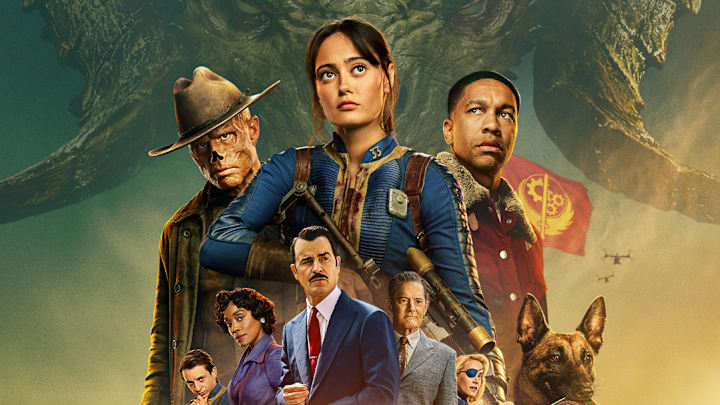
The Fallout Season 2 finale arrived in New Vegas and detonated everything. From Macaulay Culkin's shocking Legate reveal to Mr. House in a Pip-Boy and Liberty Prime Alpha — here's the complete breakdown.
New Vegas Finally Delivered — And Then Some
There are finales that wrap things up neatly. There are finales that set up the next season. And then there are finales that do both while also detonating the entire premise of the show you thought you were watching and leaving you staring at a blank screen for a solid twenty minutes afterward.
Fallout Season 2's finale, "The Strip," belongs firmly in that third category.
We made it to New Vegas. After a season of building, teasing, and occasionally maddening restraint, the showrunners finally let us walk the Strip — and then immediately showed us that nothing about what's happening there is as clean or manageable as anyone hoped. The NCR is holding the casino district. The Legion is at the gates in full civil war mode. The Brotherhood is somewhere in the middle of all of it. And our three main characters are, as always, caught in the center of a situation that nobody designed them to survive.
If you're still processing the post-credits sequence, or trying to understand what "Phase 2" actually means, or just need to talk through the Thaddeus situation with someone who shares your pain — let's go through this together.

The Cold Open: Caesar's Legion Falls Apart in the Most Fallout Way Possible
The opening sequence is the show doing something it does better than almost any other video game adaptation: capturing the specific dark humor of the source material without turning it into parody.
The Legion is in crisis. Caesar is dead. The succession is chaos. And the central joke that anchors the entire sequence — the old Kaiser leaving a note that nobody can read — is so perfectly calibrated to the Fallout universe's sense of humor that longtime players will feel it in their bones. Power changes hands in this world through violence and incompetence in roughly equal measure, and the cold open captures that balance exactly.
Macaulay Culkin as the Legate: A Casting Choice That Earns Every Second
This was not something anyone had on their prediction lists going into the season, and the show is aware of that. Culkin's casting is designed to produce a specific cognitive dissonance — the face of childhood cinema's most beloved resourceful kid, now delivering lines about total domination with the settled calm of someone who has never once considered mercy as an option.
When the new Legate states "I am the Legion" — with that specific, unnervingly quiet delivery — the scene works on multiple levels simultaneously. It's chilling as a villain introduction. It's darkly funny as a piece of deliberate casting subversion. And the detail about building "Caesar's Palace" — a joke that's been sitting in the lore since the games, finally deployed in live action — lands as the kind of reward that the show has been building toward for people paying close attention.
It's a remarkable performance in a small amount of screen time. The Legion under this Legate is going to be a different and arguably more frightening entity than it was under its founder.

Mr. House Is Alive — And He's Moved Into Your Pip-Boy
Let's acknowledge the moment directly: this reveal was handled correctly.
The "Mr. House is alive" theory has been circulating in fan communities since Season 1. The show knew the audience suspected it, and rather than obscuring the confirmation or burying it in ambiguity, it staged the reveal with the specific theatrical confidence that the character deserves. House, hooked into cold fusion technology, recounting the number of times he has been stabbed and shot across the course of the games' events — with the energy of someone who found the whole experience mildly inconvenient — is exactly the characterization the games established.
For players of New Vegas specifically, the moment carries additional weight. Many of them were personally responsible for several of those stab wounds.
The Pip-Boy Twist: What It Actually Means
The reveal that House has uploaded his consciousness into a Pip-Boy — making him genuinely portable, genuinely inescapable for whoever carries him — is the kind of structural decision that changes a show's dynamic completely.
Cooper Howard, the Ghoul, is now operating with the consciousness of one of the Fallout universe's most arrogant, most calculating, and most fundamentally amoral power players strapped to his wrist. House doesn't believe in people — he believes in systems, resources, and the efficient application of leverage. Cooper is a man defined entirely by personal loss, personal rage, and the slowly reassembling memory of who he was before the bombs fell.
The banter potential here is, as advertised, significant. But more than comedy, the dynamic sets up a genuine ideological conflict: House wants to rebuild civilization on his terms, which involve being in charge of it. Cooper wants his family. Those goals will align exactly as long as they align, and not a second longer.
Think of it as Cortana from Halo, but with a deep personal investment in market efficiency and a documented history of letting people die when the math suggested it was optimal.

Maximus: The Hero Arc Completes Itself
The Maximus storyline in the finale is the season doing something that good action storytelling earns the right to do: letting a character be unambiguously, uncomplicated heroic in a world that usually punishes that quality.
Watching him stand against a Deathclaw horde — alone, on the Strip, shoulder rockets deployed — is the kind of sequence that reminds you why you care about this person. The Brotherhood trained him to follow orders. The season spent its runtime showing him gradually understanding that following orders and doing the right thing are not always compatible. The finale is the payoff: he's not following orders anymore. He's just protecting people because that's what he decided a knight actually does.
It's a clean, earned moment of heroism, and the show is smart enough to let it breathe.
Thaddeus: The Body Horror Complication
And then immediately after letting you feel good, the show delivers the Thaddeus situation.
Thaddeus has functioned across the season as comic relief with genuine emotional weight underneath — a combination that's harder to sustain than it sounds. His injury — losing the arm, specifically the distinctive "thumbs up" gesture that has defined his character's visual language — is played first as tragedy and then, as the regeneration begins, as something considerably more unsettling.
The body horror of the distorted regeneration process — flesh reassembling incorrectly, limb structures that don't match what a human arm should look like — has the specific visual signature of Centaur mutations in the game lore. Centaurs are among the Fallout universe's most disturbing creatures: multi-limbed, multi-faced amalgamations that result from extreme forced evolution gone wrong.
If the show is taking Thaddeus in that direction, the emotional payoff of the earlier comedic affection for him becomes genuinely devastating. That appears to be the intention.

Lucy's Darkest Moment and What It Cost Her
The Lucy storyline in the finale is the hardest to watch, which is appropriate given how carefully the season built toward it.
Lucy has been the show's moral center from the beginning — not naively, but earnestly. Her "Okey Dokey" energy was never portrayed as stupidity; it was portrayed as a genuine philosophical commitment to decency that the wasteland repeatedly tested. The question the season has been asking is how much that commitment can survive before it changes into something else.
Hank's True Colors and What They Mean
The revelation of Hank's actual intentions — his plan to reduce humanity to something manageable, something controllable, removing agency in the name of safety — is the most complete form of the show's recurring argument about the nature of vaults. The vaults were never about survival. They were about control. Hank is the logical endpoint of that ideology: someone so committed to protecting people that he's willing to destroy what makes them worth protecting.
The moment Lucy uses a control chip on her own father — turning his own tool against him, trapping him inside the hive mind he was prepared to inflict on others — is the show's most precise piece of poetic justice.
But the camera doesn't let you enjoy it. The expression on Lucy's face in that moment is the show's real statement: she did the right thing, and it cost her something real and irretrievable. She's not the "Okey Dokey" girl anymore. She's someone who has done what had to be done, and that's a different kind of person. Not worse — but changed in ways that don't reverse.

Cooper Howard and the Road to Colorado
The flashback structure of Season 2 paid off in the finale with a revelation that recontextualizes not just Cooper's story but the entire political landscape the show is operating in.
Cooper wasn't just a casualty of the war and the bombs. He was actively framed — designated as a Communist sympathizer specifically to protect Vault-Tec's secrets and eliminate someone who was getting close to the truth. The "You Never Know" campaign imagery haunting the flashbacks is the show doing its best work visually: the propaganda that shaped an era being turned against the person who helped create it.
The Colorado Connection
The clues about his family's location point toward Colorado — and for players of Fallout Tactics, this opens up lore territory the main series hasn't explored in live action yet.
Colorado in the Fallout universe is Enclave territory in the deepest sense. Cheyenne Mountain. Pre-war military installations repurposed for post-war operations. The specific flavor of American institutional evil that built the vaults and built the bombs is concentrated there.
Cooper Howard, traveling to Colorado to find what's left of his family, is walking directly into the heart of the system that destroyed his life. That's not a revenge story. That's something considerably more complicated and potentially more interesting.

Steph's Reveal: The Best Long Game of the Season
In retrospect, the signals were present throughout — the competence that exceeded her apparent position, the specific way she responded to pressure, the moments where her knowledge of systems and protocols suggested experience that middle management shouldn't provide.
The reveal of Steph as a deep-cover Enclave operative lands with the specific satisfaction of a mystery that was hiding in plain sight. The wedding dress, the black-ops Pip-Boy activation, the Canadian origin — these details are delivered quickly and efficiently, trusting the audience to absorb them without over-explanation.
What "Phase 2" Actually Suggests
The question of what Phase 2 entails is the season's most deliberate cliffhanger, and the show is wise not to specify. What we know: it involves the vaults, it involves Enclave resources, and Steph is positioned to activate it.
The most ominous possibility in the lore context is FEV — the Forced Evolutionary Virus, which has served in multiple games as the mechanism for mass mutation and population control. If the Enclave is introducing something biological into the vault systems, the implications for everyone we know who lives in or connects to a vault are severe.
The show hasn't confirmed this. It hasn't needed to. The ambiguity is doing its job.

The Post-Credits Scene: Liberty Prime Alpha Changes Everything
The finale's visual montage before the credits is earned and elegantly constructed. The NCR holding the Strip. The Legion at the gates. The "Casino" sign with enough letters burned out to read "SIN" — a piece of environmental storytelling that the show didn't over-explain or draw attention to, trusting viewers to find it.
And then the post-credits sequence.
Cleric Quintus activating Liberty Prime Alpha is the kind of escalation that resets the scale of the conflict. In Fallout 3 and Fallout 4, Liberty Prime is a 40-foot combat robot with nuclear warheads and a deep personal commitment to eliminating communism — the latter being a feature of its programming, not a metaphor. It is not subtle. It is not precise. It is a weapon designed for a kind of war that the wasteland technically isn't having anymore, deployed anyway because the people controlling it have decided the situation warrants it.
The Cooper Problem
Here's the specific complication the show is now navigating: Cooper Howard, the central character of the series, is a registered Communist sympathizer in the historical record. That designation was false — it was a frame-up — but Liberty Prime's targeting systems don't run on nuance.
A 40-foot nuclear robot programmed to destroy communists is now operational on the West Coast. Cooper Howard is on record as a communist. The Brotherhood of Steel has access to it. This is a problem with multiple dimensions.

What the Lore Tells Us About Season 3
For viewers who want to understand the broader Fallout universe context heading into a potential third season:
The NCR-Legion conflict on the Strip mirrors the central political conflict of Fallout: New Vegas almost exactly — which means the show is now operating in territory that game players know extremely well. The showrunners will need to either follow the game's logic to one of its established endings or chart a genuinely new course. Either decision carries significant implications.
Liberty Prime's Western deployment represents a major power shift. In the games, Prime was an East Coast asset. Moving it West changes the Brotherhood's military posture significantly and puts them in direct conflict with both the NCR and the Legion on new terms.
The Enclave's "Phase 2" is the wildcard. Whatever Steph activates is going to affect the vault populations — and potentially Lucy specifically, given her origin.
Colorado as Season 3's setting opens the Fallout Tactics territory for the first time in the live-action series, with Cheyenne Mountain as the likely destination and deep Enclave infrastructure as the primary antagonist environment.
Common Mistakes When Interpreting the Fallout TV Lore
A few things worth clarifying for viewers who want to engage with the lore accurately:
- The show is set in its own canonical timeline. Events may differ from game endings you chose — the show follows specific canonical outcomes, not player choices.
- Mr. House in a Pip-Boy is not established in the games. This is the show's original addition to the character — canon to the show, not to the games specifically.
- The NCR's presence in New Vegas doesn't mean the Hoover Dam battle has concluded. The show is deliberately ambiguous about where exactly that conflict stands.
- Macaulay Culkin's Legate is an original character. No direct game equivalent exists for this specific figure, though the Legate role itself is established lore.
FAQ: Fallout Season 2 Finale Explained
Is Mr. House really alive in the Fallout TV show? Yes. The Season 2 finale confirms that Mr. House survived through cold fusion technology and has subsequently uploaded his consciousness into a Pip-Boy, which is now in Cooper Howard's possession.
Who is Macaulay Culkin playing in Fallout Season 2? He plays the new Legate of Caesar's Legion — the military commander who takes power following the chaos of Caesar's death. The character is an original creation for the show, not directly adapted from a specific game character.
What is Liberty Prime Alpha? A larger, upgraded version of Liberty Prime — the giant military combat robot from Fallout 3 and Fallout 4. It's activated in the post-credits scene by Brotherhood Cleric Quintus and represents a major escalation in the season's conflict.
What is "Phase 2" in the Fallout finale? The show deliberately doesn't specify. Steph, revealed as a deep-cover Enclave agent, activates something connected to the vault systems. The most discussed theory among fans involves FEV (Forced Evolutionary Virus), though this hasn't been confirmed.
Is Thaddeus turning into a Centaur? The body horror of his regeneration sequence visually suggests Centaur-type mutation, which in the game lore results from extreme, uncontrolled FEV exposure. The show hasn't confirmed this outcome explicitly.
Where is Season 3 likely set? Colorado is strongly implied by the clues surrounding Cooper's family and the Enclave infrastructure referenced in the finale. Cheyenne Mountain is the specific location most fans are anticipating.
Why does Liberty Prime targeting Cooper matter? Liberty Prime is programmed to destroy communists. Cooper Howard's historical record includes a false designation as a communist sympathizer — a framing he didn't know about. The robot doesn't run on nuance.
The Wait for Season 3 Is Going to Be Painful
"The Strip" did everything a season finale should do: it resolved the immediate conflicts, escalated the larger ones, gave the characters meaningful moments of change, and created a situation heading into the next season that feels genuinely consequential rather than manufactured.
The three-way conflict between NCR, Legion, and Brotherhood is now set with actual stakes attached. Cooper has Mr. House on his wrist and his family somewhere in Colorado. Lucy has done something she can't undo and is going to have to figure out who she is on the other side of it. Maximus is a hero now, which in the Fallout universe almost certainly means the universe is about to test that status severely. And Thaddeus is... becoming something.
If the show maintains the quality of this finale into Season 3, it's going to be worth every agonizing month of the wait.
.png)


No comments:
Post a Comment