
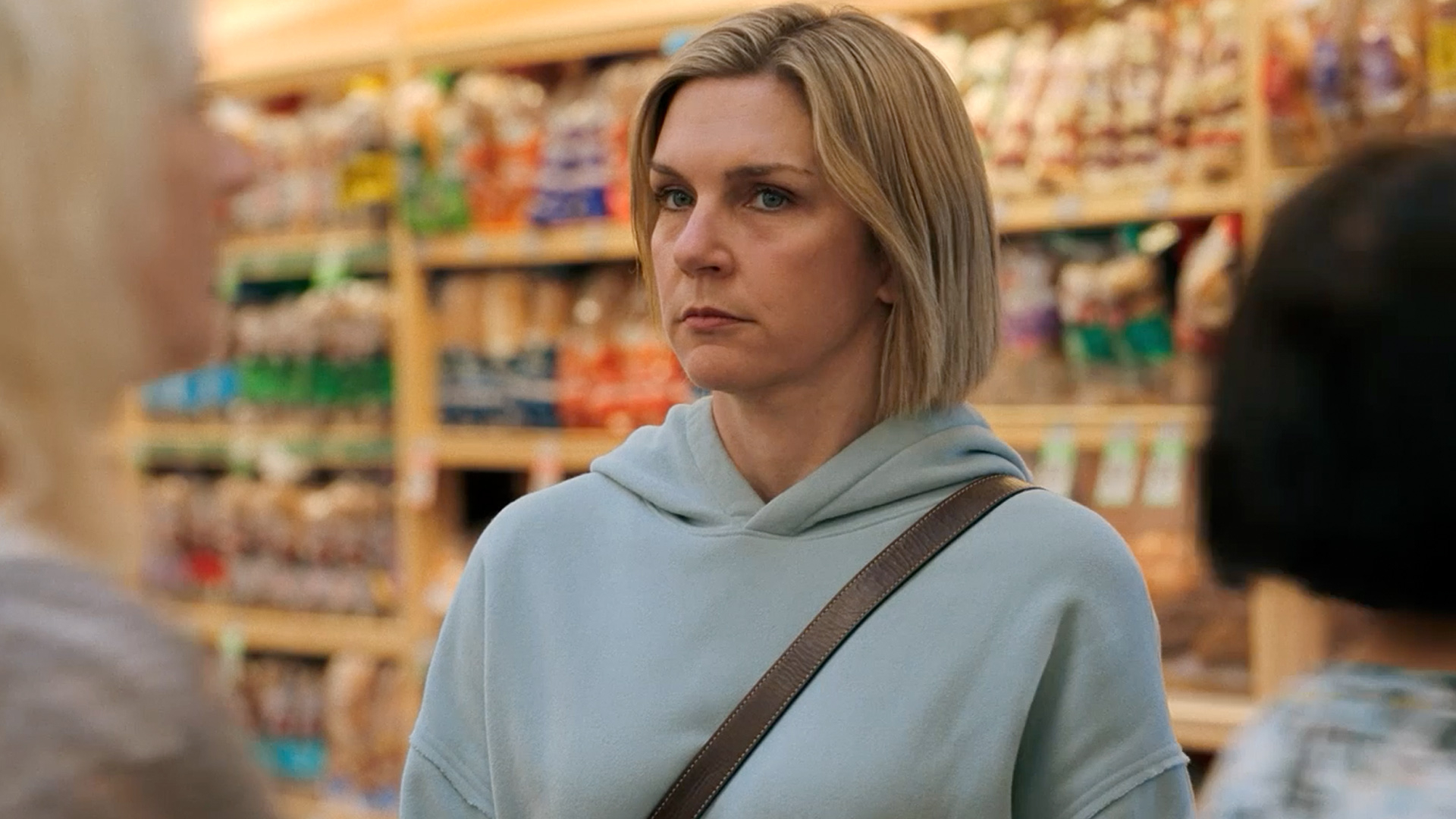
Pluribus just delivered one of its best episodes yet. Full breakdown of Carol's real motivation, the Norway flashback, Manusos's phone calls, and why Carol just became the most dangerous person alive.
Introduction: "You Just Don't Know It Yet"
Three hours staring at a wall is a completely proportionate response to that opening.
"When you saw somebody drowning, would you throw him a life preserver?" "So now I'm drowning?" "You just don't know it yet."
That exchange is doing so much work in so few words that it deserves to sit at the top of any discussion of this episode, because it is the entire show compressed into a thirty-second conversation. The Hive Mind is not performing cruelty. They are not being strategically manipulative in any way they're aware of. They are offering help. They are, from their perspective, standing on the bank of a river watching a woman drown and extending the only rope they have.
The horror is that they're right about the drowning and completely wrong about the cure.
Carol's grief — the loss of Helen, the isolation, the rage, the way she processes everything through a filter of magnificent, weaponized misery — reads as drowning to an intelligence that has optimized human experience for the absence of pain. They see someone suffering enormously and they want to fix it. The salvation they're offering is genuine. The problem is what it costs.
They're not throwing her a life preserver. They're offering to replace the drowning woman with someone who has never known how to swim and therefore never needs to be saved. The kindness of the offer is what makes it most disturbing. Villains who know they're villains are manageable. The Hive Mind believes, without any capacity for doubt, that they are the heroes of this story.
Personal rating: 9.8 out of 10. The missing 0.2 is entirely due to emotional exhaustion. I don't have the reserves to find it.
What Is Carol Actually Fighting For?
This is the question that this episode finally forces into the open, and the answer it provides is both more complicated and more human than anything the show had previously suggested.
The easy reading of Carol is that she's fighting for free will. For individuality. For the messy, loud, contradictory experience of being a human person in a world that doesn't optimize itself for your comfort. That reading isn't wrong. But it's not complete.
Watch her more carefully and a different motivation emerges, one that sits underneath the ideology and the tactical brilliance and the spectacular misanthropy. Carol wants the right to mourn.
The Hive Mind is treating Helen's death as a software error — a source of suffering that should be patched, addressed, corrected. They approach Carol's grief the way a system approaches a bug: identify it, route around it, restore functionality. And Carol's specific, particular, absolutely non-negotiable objection is not primarily philosophical. It's personal. She wants the world back to the exact state it was in when Helen was alive — broken and cold and frequently horrible — because only in that specific world does the shape of what she lost make sense.
There is something genuinely heartbreaking about a woman willing to fight a global collective consciousness for the simple right to be sad on her own terms. Not to be saved. Not to be fixed. Not to have her pain administered away by an entity that doesn't understand what Helen's absence actually weighs. Just to sit in the wreckage of the life she had and feel it.
It is, in the most unexpected possible way, a love story. Carol is not fighting the Hive Mind primarily because she believes in freedom as an abstract principle. She is fighting them because they keep trying to take Helen from her in the only way Helen still exists — as the specific, irreplaceable texture of Carol's grief.
That's the engine running underneath everything else. And once you see it, it reframes every aggressive, impossible, furious thing Carol does as an act of devotion rather than stubbornness.
The Norway Flashback: Purple, Ice, and the Only Time Carol Was Scared of Being Happy
The 2017 flashback to the ice hotel in Norway is the episode's emotional centerpiece, and the visual language it uses deserves careful attention.
Purple is everywhere. The scarf. The tint of the Northern Lights against the snow. The shadows under Carol's eyes. Purple sits at the intersection of two meanings that apply to Carol simultaneously: royalty — authority, distance, the refusal to be ordinary — and bruise. The deep, specific color of a wound that has healed over but not gone away. The show isn't using purple decoratively. It's marking Carol as someone who is both regal and damaged at the same time, and has been since well before the Joining arrived to complicate everything.
Helen is glowing. That's the only word for it. She's present in the way that people are present when they've stopped managing their own experience and simply allowed themselves to be where they are. The Northern Lights are doing something most people experience as transcendent and she's letting them be exactly that — transcendent and beautiful and worth stopping for.
Carol is running a mental Yelp review. She is calculating whether the cost-per-night of sleeping on a literal block of ice in a hotel that melts every summer justifies the experience. She is, in the most characteristic possible way, defended against being moved.
And then Helen tells her to hush.
The moment that follows — Carol actually going quiet, actually letting the lights do what lights do when you stop narrating them — produces the only version of Carol we see in this episode that looks genuinely, terrifyingly happy. Not the controlled satisfaction of executing a plan well. Not the dark glee of finding a tactical advantage. Something more undefended than either of those. Something that looks like the thing she has been spending every episode since Helen died refusing to feel again.
She is scared of it because she knows what it costs. Happiness requires having something to lose. And Carol, who has already lost the thing that made happiness possible, cannot afford to let herself remember what it felt like to have it. The ice hotel metaphor lands precisely because it is beautiful and impermanent by design — something built every winter to melt every summer, explicitly not meant to last. Carol understood that about happiness before the Joining ever arrived to confirm it.
She let herself be happy once, in Norway, with Helen telling her to hush under the Northern Lights. And now she's here.
Manusos on the Phone: The Comedy We Needed
The escalating phone call sequence is the episode's tonal relief valve, and it earns every laugh precisely because it arrives at exactly the right moment.
Call one goes to voicemail. This is the most dignified possible response to an unexpected call from a stranger claiming to be the world's most miserable person fighting a global collective consciousness. Manusos has no reason to answer and doesn't.
Call two: he hears her voice and hangs up immediately. Not angrily. Not dramatically. Just — nope. The specific efficiency of that response, the complete absence of curiosity or courtesy, is the funniest thing the episode does. He has decided, in the time it takes to process that the call is real and not a Hive Mind trick, that whatever this is, he does not want it.
Call three produces the response that the entire sequence has been building toward, and it's perfect in its specificity. Pure, unfiltered, deeply relatable annoyance at the apocalypse. Manusos doesn't have a mission. He doesn't have a philosophy. He has a Paraguay storage unit and the singular desire to be left alone to dislike things in peace, and this woman keeps interrupting that.
The reason this subplot works beyond simple comedy is what it represents thematically. Manusos and Carol are the same kind of person — resistant not out of ideology but out of constitution. They are people for whom submission to collective comfort is physically impossible, not because they've thought their way to a principled opposition but because they are built wrong for it. Or, depending on your perspective, built exactly right.
The eventual meeting of these two people — two disasters who survived the Joining purely through the force of their own intractability — is going to be one of the show's defining relationships. They will probably sit in silence together and dislike things, and it is going to be the most earned companionship the series has produced.
The Massager: When Helpfulness Becomes Invasion
The scene with Zosia and the massager is the one I had to pause.
Helen ordered it before she died. A surprise — the specific, intimate act of someone who knew their partner well enough to know what they needed before they asked for it, and planned accordingly. It arrived after she was gone. And the Hive Mind, in the course of their cheerful management of logistics and mail and the administrative texture of Carol's life, delivered it.
They thought they were being helpful. They were completing a pending action item. In the architecture of their thinking, this was a kindness — ensuring that something Helen wanted Carol to have arrived safely.
What they actually did was commit a psychological home invasion.
The massager is not a package. It is Helen's last act of love, concretized into an object. It is the specific evidence that Helen was thinking about Carol in the days before she died — thinking about her comfort, her body, her small daily needs. It is the last thing Helen chose to give her. And the Hive Mind turned it into a delivery.
They stripped the meaning from it by treating it as logistics. By touching it with their efficient, well-intentioned, fundamentally incapable-of-understanding hands and making it into something received rather than something given.
Carol demanding that they forget Helen is not grief talking. It is the most precise defensive move she has made in the entire series. She is drawing a line around the only territory that matters: Helen exists now only in Carol's memory, in the specific and irreplaceable way that Carol holds her, and the Hive Mind does not get access to that. They can have the world. They cannot have her.
It is both the saddest and the most powerful thing Carol has done, and the episode understands this without underlining it.
The Grocery Store Sequence: Infinite Resources, Still Starving
Ten trucks. An entire store restocked in minutes. The full logistical weight of a global collective consciousness deployed in service of getting Carol her sprouts.
This is not generosity. The show frames it correctly as something more unsettling than generosity — a demonstration of what the Hive Mind is capable of, disguised as an accommodation. They are showing her, with ten trucks worth of efficiency, that her needs are already anticipated and exceeded before she articulates them. That her sense of independence is an administrative fiction they are politely maintaining while they wait for her to accept what they're offering.
And Carol goes home and eats a soggy microwave dinner anyway.
That image — the sprouts available, the store restocked, the resources of an impossibly coordinated global system directed at her comfort, and Carol in her kitchen eating something genuinely unpleasant out of a plastic container — is the episode's most efficient visual summary of who she is. She is not fighting the Hive Mind because she lacks access to what they provide. She is fighting them because what they provide is not what she wants. She wants something they cannot manufacture, stock, or deliver in ten trucks.
She wants things to be the way they were. She wants Helen. She wants the right to need things that can't be supplied. And she will eat a bad microwave dinner in a fully restocked world rather than accept a happiness she didn't choose.
There is something genuinely admirable about that, even as it is obviously self-destructive. The show holds both of those things simultaneously, which is part of why Carol is one of the most interesting characters on television right now.
The Grenade and the Cheat Code: Carol Just Won
The final sequence is where the episode earns its 9.8.
Anxiety medication mixed with vodka while Zosia delivers a hand grenade is the most accurate possible encapsulation of Carol's situation — simultaneously numbing the weight of everything she's carrying and being handed escalating tools by an entity that literally cannot distinguish between what she needs and what she asks for.
The Hive Mind cannot process sarcasm. They are literal. They are algorithmic. They operate on the sincere interpretation of requests, because the collective consciousness that has replaced human individuality for most of the world's population does not have the social history or the psychological architecture to understand that language sometimes means the opposite of what it says. When Carol asks for something dangerous, they hear a need to be met, not a rhetorical point to be understood.
"Would you like an atom bomb?" is not a joke to them. It is a genuine inquiry about whether this resource would satisfy this person's expressed desire. Their sincerity in asking it is the funniest and most terrifying thing simultaneously.
Carol's face in that final moment is the inverse of the ice hotel. In Norway, she looked at something beautiful and was scared of being opened by it. Here, she is looking at the full scope of what she has just accidentally stumbled onto — the specific vulnerability of an all-powerful system that takes her at her word — and the thing she's scared of is what she's about to become.
She is a grieving widow who has just been handed the launch codes to the entire enemy fleet. Her negativity physically hurts them. Her sarcasm is indistinguishable from sincere requests. Her emotional state — the misery they are trying to relieve — is a direct transmission into the collective that the collective cannot tune out or defend against.
She is not a weapon they can see. She is the specific kind of virus that a system optimized against happiness has no immunity to.
What This Changes Going Forward
Carol's tactical position at the end of this episode is unprecedented, and the implications for what comes next are significant.
The Hive Mind's fatal flaw has been identified: they optimize for her happiness, they cannot lie, and they cannot distinguish between a genuine request and a profoundly sarcastic one. Combined with the emotional transmission effect — the way her sustained negativity registers as physical pain in the collective — she has two entirely different attack vectors available to her.
She can ask for things that will neutralize the Hive's infrastructure by framing them as personal needs. She can make their coordination mechanism physically unbearable by simply continuing to feel what she feels. She doesn't need conventional weapons. She is the weapon.
The question the show is now building toward is whether Carol can maintain the discipline to use this deliberately rather than reactively. Because Carol has never been particularly interested in strategy when pure spite is available as an option. The difference between accidentally becoming the most dangerous person alive and consciously operating as one is the difference between this season and the next phase of the story.
Manusos is out there with technical skills she needs. The cure exists, confirmed by the Hive's inability to deny it. And Carol has just discovered that the thing she has always been — difficult, specific, impossible to accommodate, resistant to prescribed happiness — is not a liability in this fight.
It is the entire fight.
Common Mistakes in Reading Carol's Character
A few interpretations that flatten what the show is actually doing:
Treating Carol's misery as a personality quirk rather than a grief response. Her baseline negative disposition preceded Helen's death, but what has made it specific and intractable since the Joining is the loss. These are different things and the show knows it.
Reading her as a hero. She is not a hero. She is a person whose specific damage happens to be incompatible with the world the Hive Mind is building. Those are different categories and the distinction matters for where this story goes.
Assuming Manusos is going to be a straightforward ally. He is exactly as difficult as Carol, in exactly different ways, and their eventual collaboration is going to create as many problems as it solves.
Treating the Hive Mind as stupid for not understanding sarcasm. Their literalness is not a stupidity — it's a consequence of removing the social friction that sarcasm evolved to navigate. They are not capable of the kind of relationship where indirect communication is necessary, because their communication is total and direct. The vulnerability is structural, not intellectual.
FAQ: Pluribus Carol Episode Breakdown
Why does Carol's negativity physically hurt the Hive Mind? The collective shares emotional states across the network — it's part of how the Joining functions. Carol's sustained negative emotional transmission registers as discomfort in the collective the same way a damaged node disrupts a network. Her grief is literally incompatible with the system's architecture.
What was significant about the Norway flashback? It shows the only version of Carol that was genuinely happy — and what it cost her to be that way. The ice hotel metaphor establishes her understanding that happiness is temporary and therefore something to be defended against, which is the psychological root of her current refusal to accept the Hive's offered contentment.
Why did the massager scene hit so hard emotionally? The massager was Helen's last gift — evidence of her thinking about Carol in her final days. The Hive delivering it as a logistics completion rather than understanding its emotional significance represents their fundamental incapacity to understand what Carol has lost. It's the clearest demonstration in the episode of why the Hive's kindness misses the point entirely.
Is Manusos going to become a significant character? Everything the show has established about him — the technical skills, the survival methodology, the fact that Carol has now made contact — points toward a significant role. The dynamic between these two specific people is the show's most interesting unresolved thread.
What is Carol's actual strategy now? She doesn't have one yet, consciously. She has accidentally discovered the Hive's vulnerability — their literalness, their inability to process sarcasm, the physical effect of her emotional state on the collective. Converting that accidental discovery into a deliberate strategy is what the next episodes appear to be building toward.
Does the Hive Mind actually think they're helping? Yes, completely and without any accessible doubt. Their self-conception as benevolent is total. This is the show's most sophisticated horror element — an antagonist that is genuinely trying to reduce suffering, that has genuinely succeeded at reducing most of the world's suffering, and that is still absolutely wrong about what it's doing to Carol specifically.
Conclusion: The Most Dangerous Woman Alive Just Found Out What She Is
What this episode accomplished, beneath all the comedy and the grief and the vodka-and-anxiety-meds dark comedy, is the establishment of Carol's actual power.
She is not powerful because she is smart, though she is. She is not powerful because she is brave, though the argument could be made. She is powerful because she is irreducibly herself — because the specific shape of her damage and her love and her refusal to be curated into someone else's version of acceptable cannot be accommodated, optimized, or routed around.
The Hive Mind built a system that makes humans happy. Carol is the edge case that breaks it — not because she's trying to, but because she simply cannot stop being exactly what she is, which is someone who needs the right to be sad more than she needs to be saved.
In Norway, under the Northern Lights, with Helen telling her to hush, she was briefly, terrifyingly, perfectly happy.
And she is going to burn the entire world down to protect what that happiness cost her.
That's the show. And I cannot wait to see what she does next.
.png)


No comments:
Post a Comment